The Art of Feeling
After years of chasing precision, Riverview artist Nick Mansito is discovering a different measure of meaningful art, not how perfectly it is created, but how deeply it is felt.
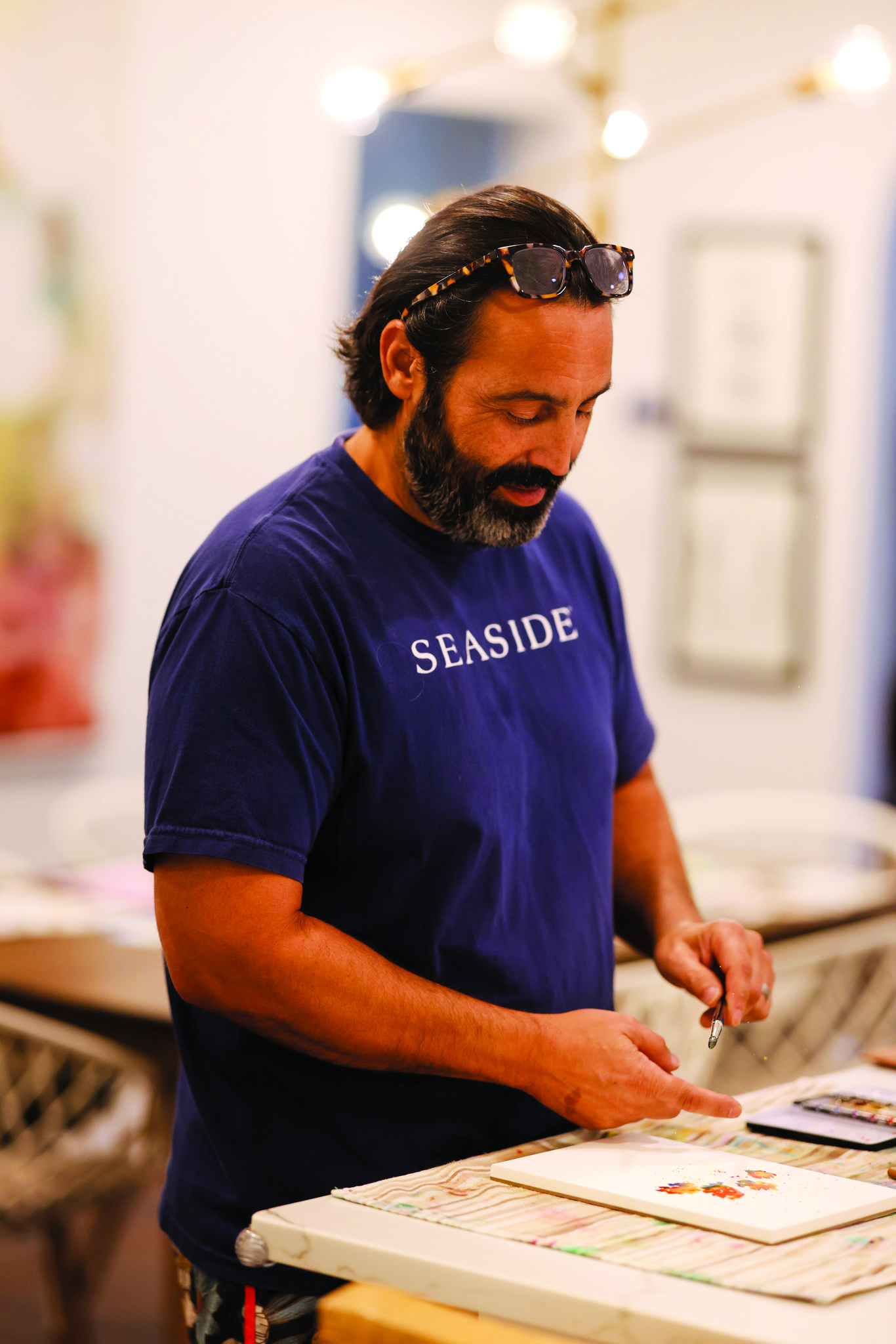
Art has followed Nick Mansito through nearly every season of his life, but his relationship with it has changed along the way.
It began when Nick was only five or six, tagging along to painting classes with his mother. The instructor decided that if he was going to be there, he was going to paint, too. Surrounded by adults, Nick began working with oils and later pastels, starting a creative practice that would remain with him even as life carried him in other directions.
Nick eventually earned bachelor’s and master’s degrees in English, followed by a PhD in Latinx Studies and Creative Writing. Writing, literary translation, teaching, career, and eventually fatherhood filled his days. Art remained, but mostly in the background.
Then his son, Myles, asked him to draw Pokémon. Nick began sketching characters for Myles to color, showing him how an image could be broken into simple shapes, drawn in pencil, inked, and brought to life with color. In teaching his son to create, Nick found himself drawn back to creating, too. This time, however, something was different.
For much of his life, Nick had approached art with precision. He wanted a finished piece to look exactly like its reference, and without formal artistic training, he often questioned whether his work was good enough. Returning to art as an adult has slowly challenged him to let go of both ideas.
Today, Nick primarily works with ink, watercolor, and markers, creating trees, landscapes, buildings, flowers, and pieces inspired by urban sketchbooks and travel journals. His work has become looser and more expressive, with less emphasis on getting every detail exactly right.
One of his favorite recent pieces emerged from that freedom. After painting with his children, Nick saved a sheet of paper covered in leftover washes of blue and ochre watercolor. He began drawing trees over the unexpected background with a dip pen, returning to it little by little until a forest scene took shape. Nothing about the piece began with a perfect plan. That may be exactly why it mattered.
After several pieces that had not turned out the way he hoped, Nick stopped worrying so much about the outcome and allowed himself to enjoy making something. The result became a piece he was proud to share and a reminder that meaningful art does not always come from perfect execution.
Sometimes, it comes from letting yourself feel the process. That idea now shapes the way Nick creates. Rather than asking whether every piece is technically perfect, he hopes his work carries a mood and leaves the person viewing it feeling something.
It is a fitting evolution for an artist whose creativity has always been tied to the people he loves. His mother first introduced him to painting as a little boy and, now in her 80s, continues to paint every week. Decades later, his own son unknowingly led him back to it.
Somewhere between those two generations, Nick stopped trying quite so hard to make art perfect and began allowing himself to simply make art that feels like something. And perhaps that was the art he was looking for all along.