Walking Through History: Hiking the Camino de Santiago
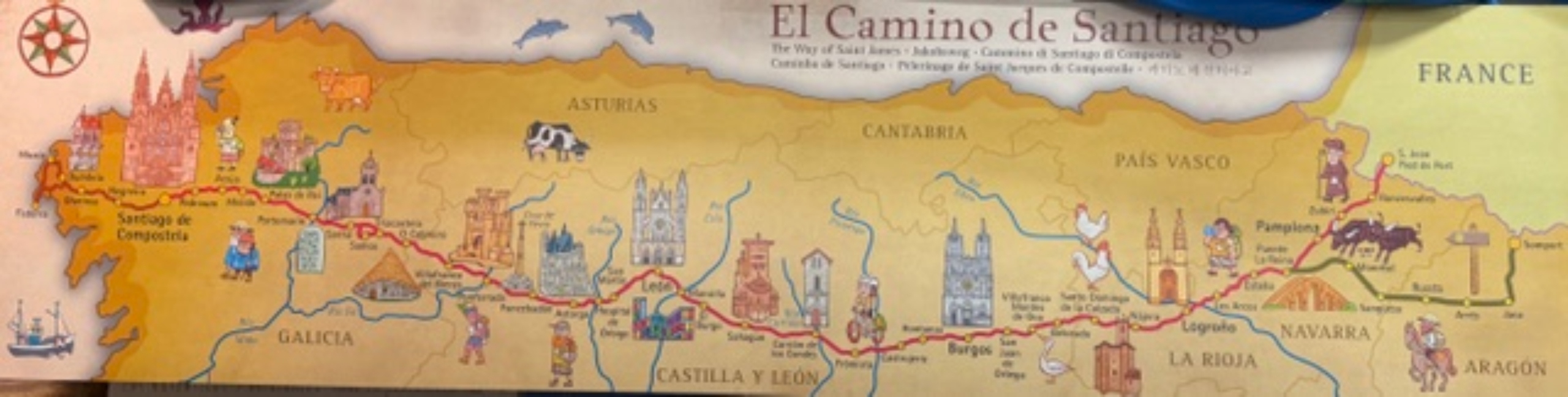
For more than 1,000 years, pilgrims have walked the ancient Camino de Santiago across northern Spain toward the legendary resting place of Saint James the Apostle in the city of Santiago de Compostela. What began in the Middle Ages as a religious pilgrimage has evolved into one of the world’s great long-distance hikes—part spiritual journey, part cultural immersion, and part endurance test.
One of the most popular routes, the Camino Francés, begins in Saint-Jean-Pied-de-Port, a picturesque village at the base of the Pyrenees in southwestern France. From there, hikers cross into Spain and travel approximately 480 miles to Santiago, often taking 30–40 days and averaging 12–18 miles daily. Routes are marked with a distinctive gold shell and have many variations with Km left to the end.
A unique Camino tradition is carrying a pilgrim passport, or credencial. Along the route, hikers collect stamps from hostels, churches, cafés, and volunteer stations—proof of progress and a treasured souvenir. The passport also grants access to many pilgrim hostels and is required to receive an official completion certificate.
I confess: I did not walk all 480 miles. But I was lucky enough to experience the final day—13 miles—with my sister, Donna, who did complete the entire trail. I jumped in front of the line, so to speak, sharing a small piece of her glory as we raced toward the Cathedral in Santiago. I want to share that experience with you.
In one day, I experienced mountain paths, hilltop cafés, fellow hikers from around the world, and the unmistakable energy of people nearing the finish of a life-changing journey. I saw volunteers stamping pilgrim passports and witnessed the subconscious acceleration that kicks in during the last few miles.
The trail itself varied constantly: gravel, dirt paths, asphalt, bridges, rocky terrain, and open farmland. The international hiking community surprised me. During my single day, I met people from Indonesia, Singapore, South Africa, Ireland, Germany, Japan, Ukraine, Spain, France, and Britain. I met a family from Atlanta who had gone to high school with my nephew, while my sister had connected with four hikers from Sarasota. It truly felt like the world had gathered on one trail.
The daily routine for most pilgrims becomes almost sacred: wake before dawn, walk for two hours, stop for coffee and breakfast at a hillside café, walk another stretch before a fruit or water break, then finish the day’s final miles before reaching the next town.
At day’s end, pilgrims check into an albergue—the Camino’s version of a hostel—or occasionally a hotel. Many albergues resemble youth hostels, with communal dining rooms, shared showers, luggage storage, and large dormitories filled with bunk beds and, inevitably, snoring strangers. Privacy is limited, but prices are friendly.
I met up with sister in Pedrouzo and stayed in a modest hotel room with two beds. She wisely packed earplugs. That evening we shared dinner with hikers from Atlanta and Barcelona. Along the Camino, meals are inexpensive, stories are plentiful, and strangers quickly become friends.
We met a pilgrim whose dog pulled his cart, another using a solar panel to charge his phone, and a family carrying a baby strapped to a parent’s chest. The diversity of people—and reasons for walking—was remarkable.
At one point, we deliberately detoured through a field for our first glimpse of the cathedral in Santiago. Only 2.8 miles remained, mostly downhill. That’s when the pace noticeably quickened among hikers. Excitement replaced fatigue.
Entering the old city, we nervously took a wrong turn before recovering with only 500 yards left. Then came a narrow tunnel filled with the sound of bagpipes, and suddenly we emerged into the plaza. The energy hit hard.
The finish is emotional for many. After weeks of walking through vineyards, medieval villages, rolling farmland, and mountain passes, pilgrims arrive at the towering cathedral. Standing in the plaza beneath it—surrounded by fellow travelers who have shared blisters, cold mornings, exhaustion, and triumph—the journey becomes more than a hike.
For my sister and her new friends, the journey was over. Pictures, high-fives, deep breaths, tears, and huge smiles marked the moment. The next stop was the Pilgrim Office to have passports certified. The lines were long. My sister was finisher number 608 that day.
Lunch, beer, ice cream, and finally a shower followed. We spent the remainder of the day exploring the massive cathedral, originally constructed in the 11th century and expanded over centuries, while running into fellow hikers exchanging congratulations and Camino stories.
I felt fortunate to witness firsthand what it takes to complete a 35-day journey. I had never walked 13 miles at one time before, and my thighs reminded me the next day.
Then it was time for my next adventure: leaving Santiago to meet my biking buddies in Vienna for a nine-day ride along the Danube River.
More on that in my next travel update.
Mike