Discovering the Duoro: A Scenic River Passage
Ingrid and Craig Dampier continue their European adventure with a river cruise on the Duoro River, uncovering vineyards, charming villages, and a landscape steeped in history.
Last month, I shared Part 1 of our 28-day adventure through Europe taking us initially from Barcelona to Madrid and on to Lisbon. This report is Part 2 following our cruise on the Duoro River in Portugal with cousin Marianne, and friend Dunja. After the cruise, we flew to Hannover, Germany – the final destination of our 28-day journey so that I could justify flying to Germany for a very special visit with friends for “4 days”.
May 21st - We took a cab down to the port to start the second stage of our trip – the cruise up the Duoro River. The road to the river was very very steep and had a lot of turns. I think it was a Double Black Diamond road, but we made it to the boat – ALVA. A little later, Marianne and Dunja came, and we were all set for the trip. Our room had a wall sized panorama window that you could lower halfway down allowing us to have great views and lovely breezes.
We learned that the Duoro River is mostly a nature reserve; the ship limited its announcements through the ceiling speakers to protect the fauna. We also learned that the boat travels during the day and then docks for the night. So, we did not leave that night, which was great because we got to see across the river at night. and in the morning, as we pulled away from the dock, we saw Porto from the river.
May 22nd - We spent the morning on the sun deck as we traveled east to Peso da Régua / Pinhão – which are both situated in the prime Douro port wine country. We saw such beautiful hills from the river to the sky. The fields of olive trees and wine vineyards were breathtaking. In Pinhão, we walked to the railroad station to view the Portuguese azulejos, which are traditional, hand-painted ceramic tileworks, covering every wall of the railroad station.
That evening, we were bused to dinner at Quinta da Avessada. We tasted a port and took a short trip around the vineyard. Dinner was a traditional meal for the workers after they finished the harvest. The winery owner told funny stories between the appetizers, meal, and dessert – he looked like Mr. Bean, and we think he really wanted to be Mr. Bean.
May 23rd – The next day our tour guide once again led us to a lovely winery. We visited Quinta de Roeda and did some red and white port tasting, and then they surprised us with a pink port that was sweet and interesting.
Afterwards, we went back to the boat and relaxed on the sun deck. The boat had to go through 5 locks upriver on our way east and down river on our return – it was interesting how high the locks were but later we saw a movie of before the locks were built that showed the waterfalls on the Douro. I have had the experience on the Rhone River of going through locks, but these were SO big and SO different than on the Rhone. We started by entering the very high cement walled lock, and then the back of the lock was sealed. Water was pumped down into the lock and we watched as our boat slowly rose to the height of the river. Our first lock at Crestum-Lever was 14 meters high. The following locks were: Carrapatelo at 35 meters, Regua at 28 meters, Valeira at 33 meters and Pocinho at 22 meters high. Totally fascinating.
May 24th – We traveled through the remaining locks to Barca d’Alva, the border between Spain and Portugal. We relaxed on the sun deck and even read a bit. Reading was constantly interrupted by the beautiful views!
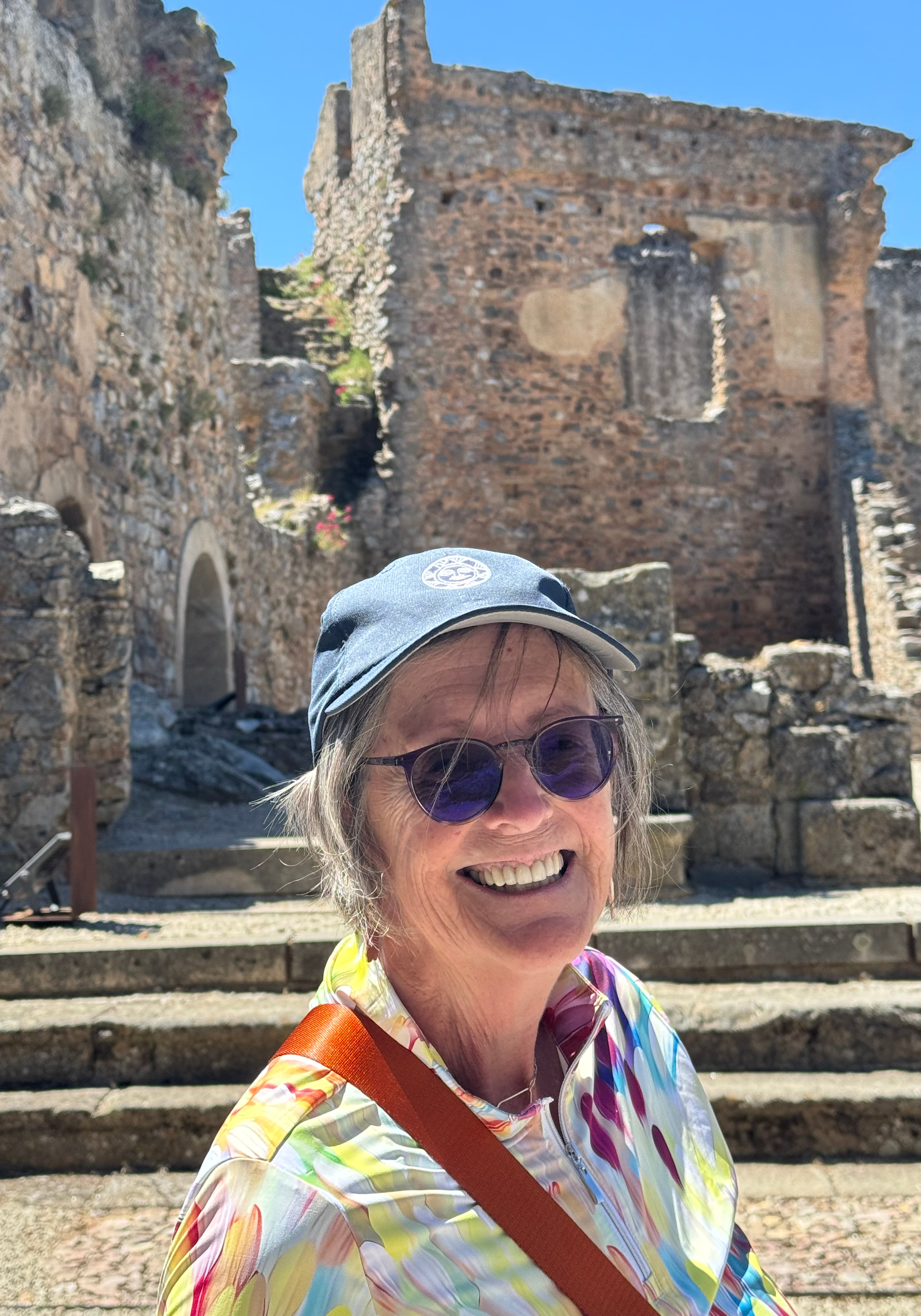
May 25th – Barca d’Alva. After we made it to port, we rented a cab to take us to Castelo Rodrigo, which is one of the historically significant villages. The first thing we saw was the Rooster on the entrance building. The castle in Castelo Rodrigo was originally built by the Arabs. In 1170, Portugal’s first king, D. Afonso Henriques, conquered the castle, but it was later conquered by the Moors. In 1297, Castelo Rodrigo returned to the Portuguese. Many armed conflicts, which destroyed some of the village and a castle, continued until 1668. This little village was so fun to walk through – particularly the castle.
Castelo Rodrigo is most famous for its almonds. After we completed walking all around, we sat on a shady porch and had some wine and almonds. The cab driver stopped when we were going back down in another village. We walked down roads where there were nets high over the road and decorated with pink flowers. Then we headed back to the ship – and chatted about our wonderful day and went to the Port Wine Event and learned how to skillfully open a bottle of vintage port (with a big knife).
May 26th – Mateus, in the municipality of Vila Real. We once again rented a cab to take us to Mateus Palace, which is still owned by the Count of Vila Ral. We wandered through the gardens – many gardeners were needed! Just so beautiful. Then we decided to do a wine tasting which was great. Our guide really knew her wine and which wines were based on the grapes from Mateus. When we returned to the ship, we celebrated our last evening on the ship with a very nice dinner and a glass of port!
May 27th – Porto. We returned to where we started in Porto. We enjoyed our last day on the ship on the sun deck with a port tonic in our hands and views of the city from the water.
May 28th – Porto. We disembarked from the ship and went to our rented apartment. We stayed in Porto for a few days after the cruise. Porto is very nice – and we will return once they have finished with their redo of the subway and the repaving of the streets and sidewalks.
What was really interesting was the Gondola along the river – and not to ski runs! We took the gondola to the Dom Luis Bridge that we walked over to see Porto and the river. After climbing a bit, we were at the Porto Cathedral. We also went to the Livraria Lello, famous for its stunning architecture, the grand, ornate staircase, and Neo-Gothic design. There is always a long line to get in so we got tickets, which meant we still stood in line for a bit, but it was worth going inside.
Livraria Lello is widely believed to have inspired J.K. Rowling's Harry Potter series, particularly the Hogwarts library and Flourish and Blotts bookstore. While there are many who do not believe that, nevertheless, the bookstore had multiple types and sizes of Harry Potter books in many languages.
The most wonderful part of Porto was the restaurants – just amazing and extremely good prices. Highly recommend Tapas & Destapas on Rua de Trás 27!
Alas, we left Portugal and flew to Hanover, Germany. Afterall, that was why we were in Europe for a “4-day visit”, and we had a lovely time with our friends. We went to Herrenhausen – the new one. Herrenhausen, the summer residence of the Royal House of Hanover, was destroyed in World War II. It was rebuilt on the original site to the original plans and opened in 2013. I had been there before but seeing it again and how much more the gardens have grown made my day! And finally, another part I really love is the grotto of the work of Niki de Saint Phalle. It was the perfect ending to our “4-day visit” in Germany!