Beautiful Chaos, Sacred Stillness
Sedgefield resident Tiffany Vestal reflects on a two-and-a-half-week journey through India—from the chaos of city streets to the peace of sunrise on the Ganges.
Beautiful Chaos, Sacred Stillness
Sedgefield resident Tiffany Vestal reflects on a two-and-a-half-week journey through India—from the chaos of city streets to the peace of sunrise on the Ganges.
“I’ve always had an insatiable interest in other cultures,” says Tiffany Vestal. That curiosity recently took her to India, a destination she had dreamed of for years.
Over the course of two and a half weeks, Tiffany explored both the well-known Golden Triangle—Delhi, Jaipur, and Agra—and less-visited regions like Varanasi in the north and Kerala in the south.
India, she says, is unlike any other place she’s been. “It truly is a country of beautiful chaos,” she explains. “There’s this vibrant cultural and religious mix—Hinduism, Buddhism, Islam, Christianity, Judaism—all coexisting. That unity in diversity is what drew me in.”
A Feast for the Senses
Tiffany began her trip in the Golden Triangle, the area most travelers imagine when they think of India.
“This part of the country is all palaces, forts, and maharajas—it’s what we’ve seen in movies,” she says. From the intricate block-printed fabrics, artisan woven sarees, and garlands of marigolds to the ever-present scent of spices and incense, she found herself captivated by the rhythm of daily life. “There’s a small temple on nearly every block, and I couldn’t get enough of the markets and street food,” she says. “The masala chai and yogurt lassis may be the most delicious things I’ve ever tasted.”
Street scenes were equally unforgettable. “You’ll see camels, cows (they are sacred in India) and elephants sharing the road with tuk-tuks, monkeys clambering along rooftops, and snake charmers with cobras swaying to the movement of the pungi,” she laughs.
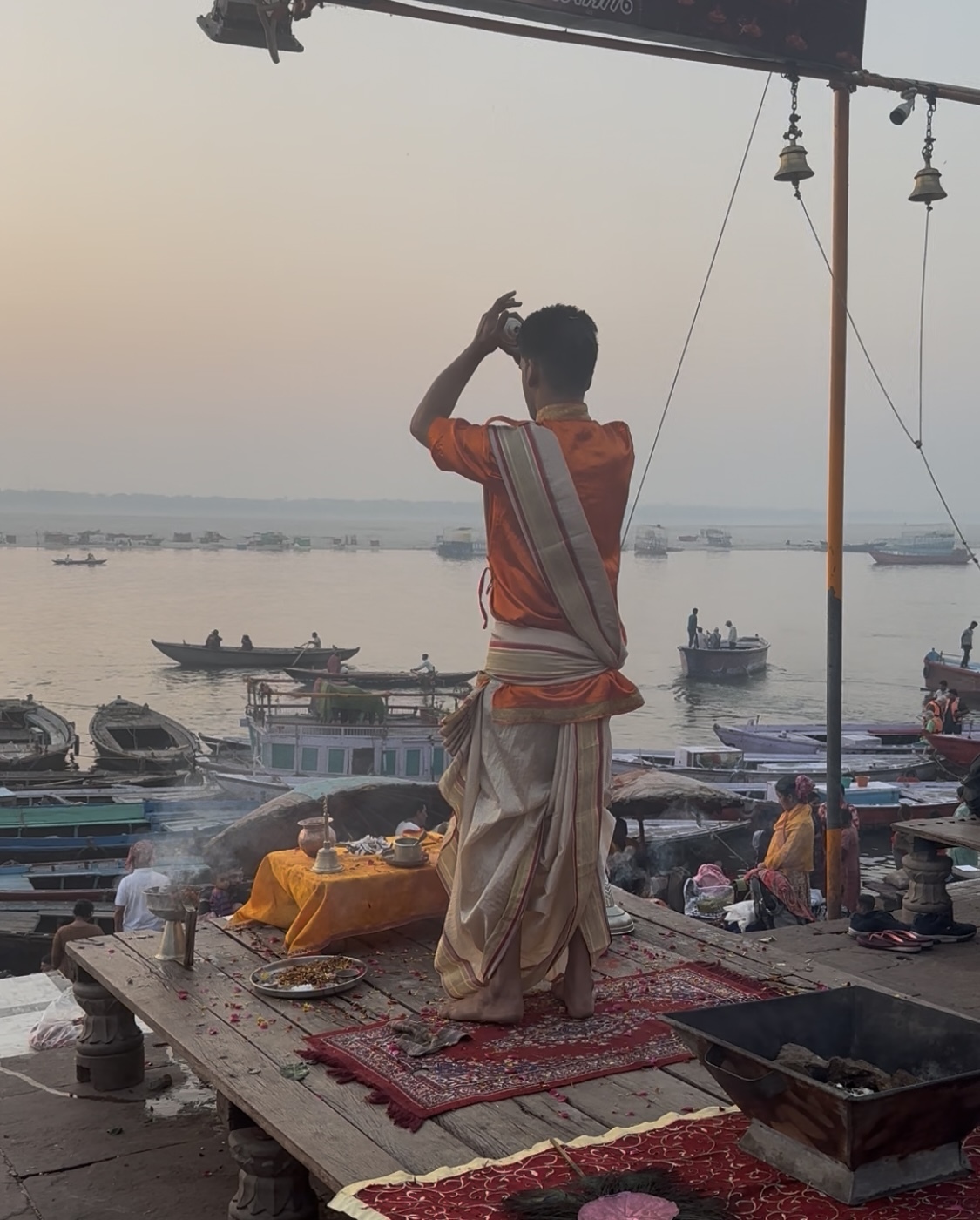
From there, she took an eight-hour train to Varanasi, one of the oldest living cities in the world and one of Hinduism’s most sacred places. “It sits on the Ganga River—what we call the Ganges—and sunrise on that river is something I’ll never forget,” she says.
Tiffany witnessed Arti rituals, visited ancient temples, and observed cremation ceremonies on the river’s ghats. “It was overwhelming, spiritual, and completely humbling,” she says. “Seeing it from a boat on the water was powerful.”
The Other India
In the second half of her trip, Tiffany flew to Kerala, in southern India—a place she describes as “a world away” from Rajasthan. “It’s tropical, teeming with spice and tea plantations, and awash with serene backwaters. It’s also the birthplace of Ayurveda,” she says. She stayed in Kumarakom on Lake Vembanad, only accessible by boat, and ended her trip in Varkala, a laid-back beach town where cliffs overlook the Arabian Sea.
“The seafood in Varkala was incredible. I had Ayurvedic treatments and explored the town by moped,” she says. In Cochin (Kochi), she explored the colonial history and cultural influences of Portuguese and Jewish settlers and learned about the area’s spice trade legacy.
“Kerala is less traditional, has the highest literacy rate in India, and is home to a large Christian population. It’s so different from the north, and the people were incredibly warm.”
Advice for First-Time Travelers
Tiffany is a seasoned traveler, but even she recommends hiring a local guide in India—especially for a first visit.
“A guide and driver can help you get where you’re going without the stress. It’s affordable, and they’ll take you to places most tourists miss,” she says. “That’s where the real India is.”
After 24 years in Sedgefield with her husband John and their kids Emory and Connor, Tiffany says she’s always looking for opportunities to explore and learn.
“If you can take two weeks or more, don’t stop at the Golden Triangle,” she says. “See the other India. It’s absolutely worth it.”