Brush, Water and a Second Act: Artist Jerry Brown
After 52 years as a traveling entertainer, a beloved neighbor found a new creative life in watercolor, light and Lancaster streets.
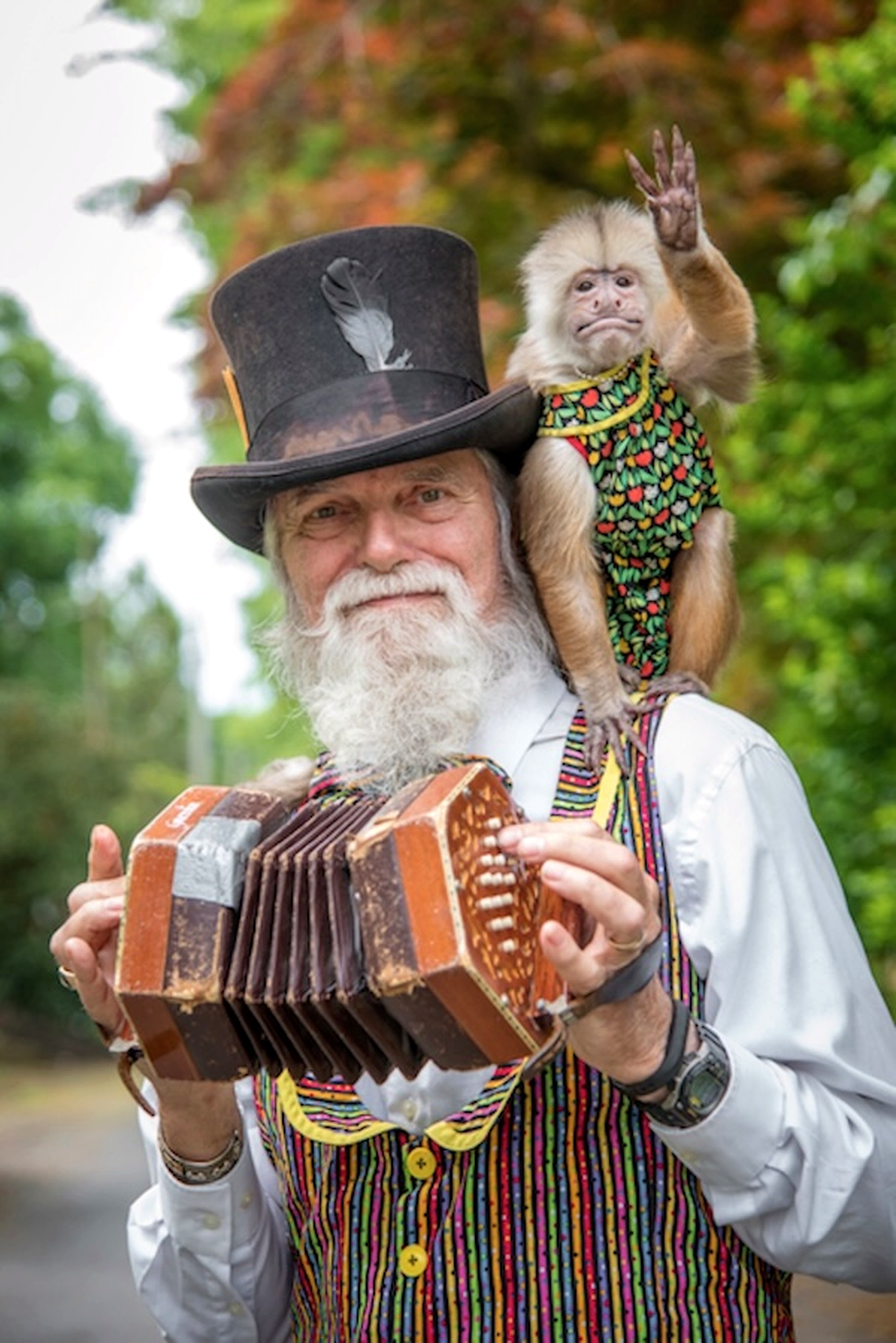
Jerry Brown as The Monkey Man
At an age when many people are slowing down, Lancaster watercolor artist Jerry Brown found himself beginning again. For 52 years, Brown made his living as a traveling variety entertainer, performing music, magic, juggling, storytelling, fire eating and stilt walking. Many neighbors may still know him by the stage identity that followed him for decades: “The Monkey Man” after Django, his primate performing partner who is somewhat of a local School Lane Hills legend on her own.
Then COVID arrived, and the calendar that had carried him from event to event suddenly emptied. Brown says, with characteristic humor, that “at the age of seventy-six, I got retired by COVID.” It was time, he decided, “to change tactics.” What followed was not a retreat from creativity, but a remarkable second act.
Brown chose watercolor almost by instinct. He had no formal visual-art background and no grand plan beyond spending three disciplined hours a day in his studio, hoping to paint Christmas gifts for family. “I had no idea what I was doing,” he says. “I had always wanted to do something visual but never had the opportunity because I was too busy making a living.”
The routine stuck. Most days, from about 1 to 4pm, Brown protects what he calls his “sacred” studio time. The space itself carries the memory of his former life: it was built with ceilings high enough for juggling and once served as the rehearsal room for educational theater programs. Today, it is filled with light, plants and paintings.
Watercolor quickly became more than a pastime. After some early online lessons, Brown found a teacher who helped him understand “how water and pigment flow.” Eventually, he stepped away from instruction because he did not want to get stuck in someone else’s vision. His own style is recognizable but not photographic. He is drawn most often to light, shadow and mood. “There’s nothing as beautiful as dappled light in the forest,” he says.
That sharpened way of seeing now follows him everywhere: on dog walks to Baker Fields with Gunny, his trusted canine partner. They often walk through Lancaster neighborhoods, take road trips to Lewes, DE and travel the Lancaster County countryside seeking new and interesting content. Gunny even accompanied Jerry during a recent three-week artist residency at Catoctin Mountain National Park in Maryland. “Every place I go,” he says, “I will see things and I go, oh wow, that would make a great painting!”
School Lane Hills has become one of those places. One winter, when deep snow kept Gunny out of Baker Fields, Brown began walking the quiet neighborhood streets. A house at Clayton and Hamilton caught his eye in the winter light. He painted it, left a small print and note for the homeowner, and the owner bought the original. That happy accident grew into what Brown playfully calls his “housing project,” a series of local house paintings.
Another chance connection led to Red Raven Art Company in downtown Lancaster. After Brown painted a friend named Caroline with her golden retrievers on the Conestoga River, word eventually reached Caroline’s aunt, the gallery manager. Brown had expected he might need to “bang on doors and beg to be seen.” Instead, Red Raven found him and signed him as an artist. He shows his work through the gallery regularly.
His upcoming work includes small paintings for Red Raven’s “Art for Everyone” event and larger “pour” pieces, a demanding technique that produces images with the feel of woodcuts or batik.
For neighbors wondering whether it is too late to begin something creative, Brown’s advice is direct: “Don’t ignore it. Don’t let it pass you by. Catch the wave.” Or, as he wrote in a poem after his Catoctin residency, “Follow your dream wherever it goes, follow the stream wherever it flows.”