Simply Slovenia
Slovenia, Slovakia? Which Did We Visit? Discovering the beauty and charm of Slovenia.
Slovenia and Slovakia are two distinct Central European countries frequently confused due to their similar names, flags, and Slavic heritage. Lots of people mix up the two countries, and even my husband Rich kept telling our friends we were going to Slovakia when, in fact, we were booked to go to Slovenia!
Slovenia is where our current FLOTUS was born. It is known and appreciated for its stunning natural landscapes, ranging from the jagged peaks of the Julian Alps to the country's Mediterranean coastline. It has a small-ish population of around 2.1 million people.
Culturally, Slovenia has a strong wine-making heritage and boasts a charming, eco-conscious, and relatively affluent society. Because it was not aligned with the Soviet Union during the Cold War, it developed distinct ties to Western Europe and gained its independence from Yugoslavia in 1991.
We flew from Frankfurt, Germany, directly to Ljubljana, its capital and largest city. A walking tour allowed us to soak in Ljubljana’s charm. Must-see sights were the Preseren Square and Triple Bridge in the heart of the city, where the Old Town meets the modern city center.
High on a hill is Ljubljana Castle, a 900-year-old fortress overlooking the city that is reached by a funicular ride. The Dragon Bridge is another well-known icon of the city that is famous for its four striking dragon statues. We also visited the Central Market, which was designed by the famous architect Jože Plečnik. Cherries were in season during our visit, so we enjoyed munching on fresh ones as we strolled.
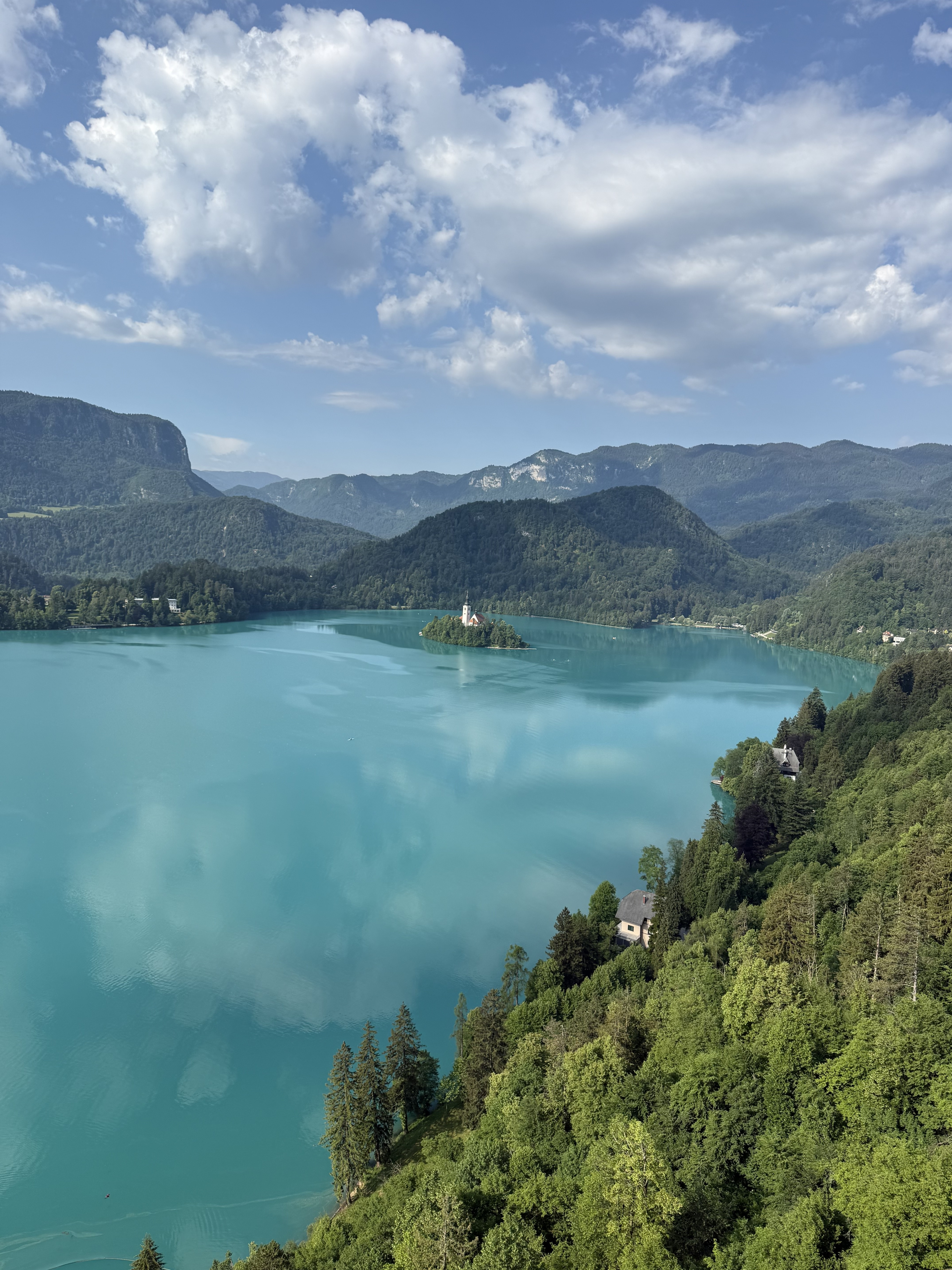
About 20 miles from Ljubljana is Lake Bled, a beautiful lake of glacial and tectonic origin. We took a leisurely boat ride on a traditional wooden boat known as a ‘pletna,’ which means ‘flat-bottomed boat.’ Some sources say the pletna was used on Lake Bled as early as AD 1150.
Similar in shape to Italian gondolas, a pletna seats 20 passengers. Modern boats are still made by hand and are recognizable by their colorful awnings. Pletna oarsmen employ the stehruder – a standing rowing technique -- to propel and navigate boats across the lake using two oars. The role of the oarsman dates back to 1740, when Maria Theresa of Austria granted 22 local families exclusive rights to ferry religious pilgrims across Lake Bled to worship on Bled Island. The profession is still restricted. Many modern oarsmen descend directly from the original 22 families.
Lake Bled is known for its striking turquoise, emerald, and deep blue colors, which come from a combination of the lake’s mineral-rich glacial meltwater, its limestone bed, and the clear reflection of the surrounding Julian Alps and sky.
On Bled Island, we spent time at Bled Castle, a medieval castle built on a precipice above the city. According to written sources, it is the oldest Slovenian castle and is currently one of Slovenia's most visited tourist attractions. Nowadays, the castle is a historical museum with a collection representing the lake's history.
After our morning at Lake Bled and Bled Island, we took a scenic five-minute cable car ride up to the top of Mount Vogel. At 1,922 meters, it is a stunning peak in the Julian Alps within Triglav National Park, towering above the shores of Lake Bohinj. It is famous for panoramic hiking, paragliding, and winter skiing. Our time at Mount Vogel was a tremendous way to cap off our time in Slovenia before heading off the next day to Croatia.
Tune in next month for a recap of our time in Croatia and the Dalmatian Isles.