Building Humanity's First Moon Base
As America celebrates 250 years of innovation, courage, and discovery, NASA is leading humanity toward its next great frontier.
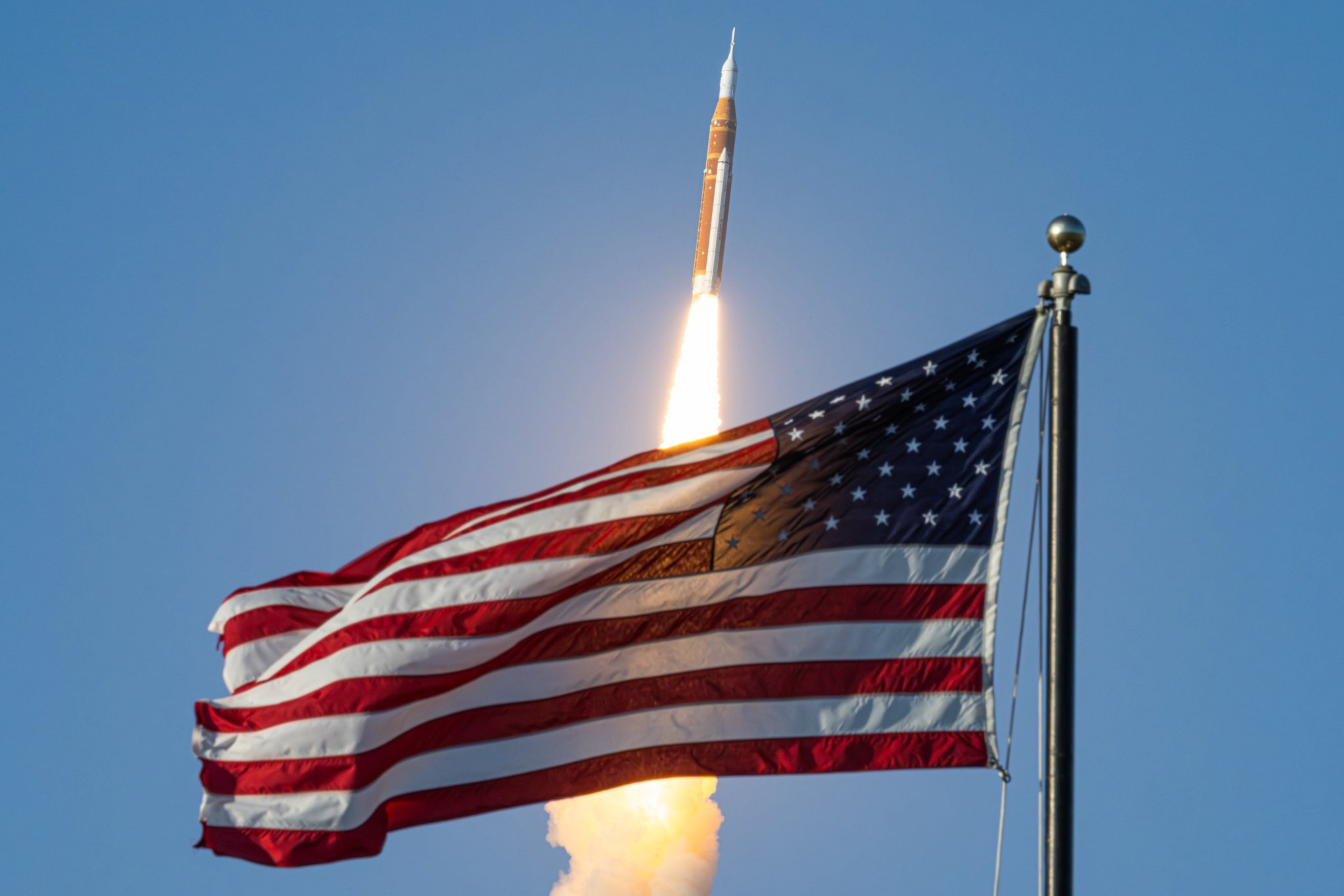
Artemis launch rising behind the American flag in Cape Canaveral, FL
For generations, the Moon has inspired wonder.
It has guided explorers, fueled imaginations, and challenged humanity to reach beyond what once seemed possible.
Today, that challenge is becoming reality.
NASA’s Artemis campaign represents the most ambitious exploration effort since Apollo. But unlike the missions of the past, Artemis is not simply about planting flags and footprints. It is about building the systems, infrastructure, partnerships, and capabilities necessary for humanity to live and work beyond Earth.
In many ways, we are witnessing the opening chapter of the next great era of exploration.
And remarkably, it is happening during America’s 250th year.
(note - photo 2)
A New Era of Leadership
Much of the momentum surrounding NASA today is being driven by a renewed focus on urgency, innovation, execution, and American leadership in space under NASA Administrator Jared “Rook” Isaacman. A successful entrepreneur, accomplished aviator, commercial astronaut, and record-setting explorer, Isaacman brings a unique combination of business leadership, operational excellence, and firsthand spaceflight experience to the agency at a pivotal moment in history.
(note - photo 3)
Isaacman’s path to leading NASA is unlike any administrator before him.
At just 16 years old, he left high school and founded a payment-processing company from his parents’ basement. That company ultimately became Shift4, a global technology enterprise serving hundreds of thousands of businesses worldwide.
His entrepreneurial success later expanded into aerospace when he co-founded Draken International, helping build one of the world’s largest private fleets of military aircraft while supporting advanced pilot training for the U.S. military. The company helped modernize military readiness while saving taxpayers billions of dollars.
But perhaps what distinguishes Isaacman most is his lifelong pursuit of exploration.
With more than 8,000 flight hours, numerous military and civilian jet certifications, world aviation records, and experience flying some of the most advanced aircraft ever built, he has spent much of his life pushing the boundaries of what is possible.
In 2021, he commanded Inspiration4, the first all-civilian orbital spaceflight in history. The mission not only demonstrated the growing capabilities of commercial spaceflight, but also raised more than $250 million for St. Jude Children’s Research Hospital.
Three years later, he led Polaris Dawn, carrying humans farther from Earth than anyone had traveled since Apollo 17. During the mission, Isaacman performed the first commercial spacewalk in history while helping advance technologies that may shape the future of human spaceflight.
Few leaders have combined entrepreneurial success, aviation expertise, military training experience, commercial spaceflight leadership, and human spaceflight experience at the scale Isaacman has achieved.
Today, as NASA’s 15th Administrator, he brings that same entrepreneurial mindset, operational discipline, and sense of urgency to America’s space program.
His vision is ambitious but clear: return Americans to the Moon, establish a sustained presence there, strengthen partnerships across government and industry, accelerate innovation, and prepare humanity for future missions to Mars.
For many across NASA, industry, and the broader space community, there is a growing sense that we are entering a new chapter of exploration—one defined not only by bold goals, but by a renewed determination to achieve them.
(note - photo 4)
Why Artemis?
Many people are familiar with Apollo, the program that first carried humans to the lunar surface and forever changed what humanity believed was possible. Fewer know the story behind Artemis, the campaign that is building on that legacy and preparing the next chapter of exploration.
In Greek mythology, Artemis was the twin sister of Apollo and the goddess of the Moon. The symbolism is fitting. Apollo carried humanity to the Moon for the first time. Artemis will take us back.
This time, however, the objective is fundamentally different. Artemis is not simply about reaching the Moon. It is about learning how to operate there, live there, and ultimately build the capabilities necessary for sustained exploration beyond Earth. Future missions will explore regions never visited during Apollo, including the lunar South Pole, where water ice and other resources may help support long-duration human operations.
Every element of the Artemis campaign is designed to answer a larger question: What will it take for humanity to establish a lasting presence beyond our home planet? For the first time in history, that question is moving from theory to reality.
(note - photo 5)
Did You Know?
Every element of the Artemis logo tells a story:
• The “A” represents an arrow launching toward the future.
• The Moon reflects humanity’s next destination.
• The red trajectory symbolizes the path toward Mars.
• The blue Earth crescent reminds us that every discovery ultimately benefits life back home.
For generations, humanity has looked up at the Moon and wondered what was possible. Artemis is transforming that question into a plan.
Artemis II: Four Astronauts. One Mission. No Room for Error.
Before NASA can establish a sustained human presence on the Moon, it must first demonstrate that the systems designed to take astronauts there can do so safely and reliably.
That responsibility falls to Artemis II.
For the first time in more than fifty years, a crew of astronauts will leave Earth orbit, travel around the Moon, and return home. The mission will carry NASA astronauts Reid Wiseman, Victor Glover, and Christina Koch, alongside Canadian Space Agency astronaut Jeremy Hansen. While the flight will last only days, the preparation behind it has taken years.
(note - photo 6)
Artemis II is often described as a test flight, but it is much more than that. It is the critical bridge between the uncrewed missions that proved the hardware works and the future missions that will place astronauts on the lunar surface. Every objective matters. Every system matters. Every decision matters.
(note - photo 7)
For the thousands of engineers, scientists, technicians, safety professionals, operators, and support teams behind the scenes, mission success is measured not only by exploration and discovery, but by bringing every astronaut home safely.
The mission will also provide humanity with a perspective few have ever experienced — seeing Earth from hundreds of thousands of miles away and viewing our home planet from deep space. Images captured during Artemis II may become as iconic for this generation as the Earthrise photographs were during Apollo.
(note - photo 8)
Bringing Everyone Home
While launches often capture the world’s attention, experienced space professionals understand that the true measure of mission success occurs at the end of the journey.
After traveling hundreds of thousands of miles through space, the Orion spacecraft must safely navigate one of the most challenging phases of the mission: reentry into Earth’s atmosphere. Returning at speeds exceeding 25,000 miles per hour, Orion will encounter temperatures approaching 5,000 degrees Fahrenheit before deploying its parachutes and splashing down in the Pacific Ocean.
The complexity of this operation cannot be overstated. Every system must perform exactly as designed. Every requirement must be met. Every detail matters. Years of engineering, testing, and preparation ultimately converge in these final moments.
(note - photo 9)
For NASA, success is not defined by how far a spacecraft travels or how many headlines it generates. Success is defined by whether the astronauts safely return to their families. That commitment has guided human spaceflight for decades and remains at the heart of every Artemis mission.
(note - photo 10)
For NASA, mission success is not defined by how far we travel.
It is defined by whether our crews return safely to their families – and, in this case, Mission Success.
The Teams Behind the Mission
When people watch a launch, they naturally focus on the rocket and the astronauts. What they rarely see are the thousands of individuals whose work makes that launch possible.
Across NASA centers and partner organizations throughout the country, teams are solving complex engineering, operational, scientific, and logistical challenges every day. Their work often happens behind the scenes, away from television cameras and public attention, but it is essential to mission success.
One example is the work performed at NASA Ames Research Center in Silicon Valley, where teams have played an important role in validating technologies associated with Orion’s thermal protection system. When the spacecraft returns to Earth, its heat shield
must protect astronauts from some of the most extreme environments encountered during flight.
(note - photo 11)
The margin for error is incredibly small. The engineering standards are uncompromising. Success depends upon discipline, expertise, and relentless attention to detail.
Much of this work may never make headlines. Yet it represents the foundation upon which exploration is built. Every successful mission reflects the dedication of thousands of people who believe deeply in advancing discovery and expanding humanity’s reach into space.
Building Humanity’s First Moon Base
(note - photo 12)
Artemis II is not the destination. It is a critical step toward something even more ambitious: humanity’s first sustained operational presence on another world.
For the first time in history, NASA and its partners are actively building the capabilities required for people to live and work on the Moon for extended periods. Future lunar operations will require many of the same systems we depend upon here on Earth: power generation, communications networks, transportation systems, mobility platforms, robotics, scientific laboratories, habitats, logistics infrastructure, and reliable supply chains.
The vision is far greater than a single mission. In many ways, the Moon is becoming humanity’s proving ground for learning how to operate sustainably on another world. It is the creation of an entirely new operational environment that enables continuous exploration and scientific discovery. The technologies being developed today will help establish the foundation for future lunar operations while providing critical lessons for eventual missions to Mars.
Equally exciting is the growing role of industry, academia, and international partners. Building a sustained presence on the Moon will require collaboration on a scale rarely seen before. Governments, commercial companies, researchers, and innovators are contributing technologies and capabilities that are accelerating progress and expanding what is possible.
What once existed only in science fiction is now being transformed into engineering plans, hardware, infrastructure, and operational systems. Humanity’s first moon base is no longer a distant dream. It is a long-term objective that is already taking shape.
(note - photo 13)
Why It Matters
(note - photo 14)
Space exploration has always been about more than space itself.
The technologies developed for exploration frequently improve life here on Earth. Advances in computing, communications, materials science, robotics, medicine, and countless other fields often emerge from the challenges associated with pushing the boundaries of discovery.
Beyond technology, exploration serves another important purpose. It inspires people. It encourages curiosity. It motivates future scientists, engineers, entrepreneurs, educators, and leaders to pursue ambitious goals and solve difficult problems.
Perhaps most importantly, exploration reminds us what humanity can accomplish when people unite behind a shared purpose. Throughout history, some of our greatest achievements have occurred when individuals from diverse backgrounds worked together toward a common objective that was larger than themselves.
As someone who has spent much of my career supporting NASA’s mission, I continue to be amazed by the talent, dedication, and passion of the people making these accomplishments possible.
Their work represents the very best of American innovation. That spirit remains alive within Artemis.
(note - photo 15)
Looking Toward the Future
(note - photo 16)
A couple years ago, my wife Bliss and I had the opportunity to experience an Artemis launch campaign firsthand at Kennedy Space Center. Standing near the launch site, you could feel the excitement and anticipation. Engineers, technicians, students, families, and space enthusiasts had gathered to witness something extraordinary. Yet what stood out most was the understanding that every visible milestone represented years of preparation, teamwork, and perseverance.
One lesson repeated throughout the history of exploration is that progress rarely follows a straight line. Spaceflight is extraordinarily difficult. New technologies must be designed, tested, validated, and continuously improved. Challenges emerge. Setbacks occur. Lessons are learned.
Recent events across the aerospace industry serve as a reminder that pushing the boundaries of exploration involves risk. Yet history consistently demonstrates that some of humanity’s greatest achievements emerge from our willingness to learn, adapt, and continue moving forward. The teams that succeed are not necessarily those that avoid every obstacle. They are the teams that respond with agility, resilience, curiosity, and an unwavering commitment to improvement.
That mindset extends far beyond spaceflight. In leadership, careers, business, and life, things rarely go right the first time. Success often belongs to those who remain adaptable, continue learning, and persevere through challenges.
Ultimately, what stays with me most is not the rocket itself. It is the people behind it. The engineers solving difficult problems. The technicians performing thousands of inspections. The operators monitoring every detail. The families supporting loved ones through years of demanding work.
Artemis is not simply about rockets, spacecraft, or destinations. It is about what humanity can achieve when talented people unite behind a shared purpose and commit themselves to something larger than themselves.
(note - photo 17)
For one generation, Apollo inspired dreams of exploration. For the next generation, Artemis may become the defining mission that shapes how humanity views its future beyond Earth. It was personally special for me to witness my daughters glued to the splashdown coverage – their curiosity and excitement are a reminder of why exploration continues to matter.
As America celebrates 250 years of innovation, courage, and discovery, NASA is once again preparing to open a new frontier.
The Moon is not the finish line. It is the beginning of humanity’s next chapter of exploration.
Photo Credits: NASA