Treasure
The seas were calm as the fog rolled in over Block Island in the early morning of May 27, 1932. Two ships sailed off the southeast coast of the island, the Grecian, a freighter headed for Norfolk, and the City of Chattanooga, a passenger liner bound for Boston. As the fog thickened and visibility decreased dramatically, each ship slowed to a fraction of its usual speed. In those days before the commercial use of radar, the ships were unaware of their proximity to one another. Suddenly the Grecian loomed out of the fog, crossing the bow of the Chattanooga. The Chattanooga crashed into the port side of the Grecian, tearing a hole in its side. Acting quickly, the Chattanooga’s captain ordered his ship to move slowly forward, keeping the prow embedded in the side of the Grecian to hold the ship afloat for as long as possible. The Chattanooga lowered lifeboats to rescue crew members, while other sailors already in the water climbed ropes to board the Chattanooga. Four crew members on the Grecian died in the initial collision, but all others were saved. It was a remarkable rescue. The Grecian sank to the bottom in just thirteen minutes.
The Grecian was loaded with freight, and close enough to shore for some of it to be salvaged. Block Islanders were ready. Fishing boats and other small craft ferried divers out to the wreck site where they retrieved what they could from the ocean The shipping company paid the salvagers for any undamaged goods they could save. Unsellable goods were quickly claimed by the islanders. The Grecian’s cargo on this trip contained bolts of multi-colored fabric that were damaged by exposure to salt water. Stained or not, free fabric was a valuable commodity for the island women.
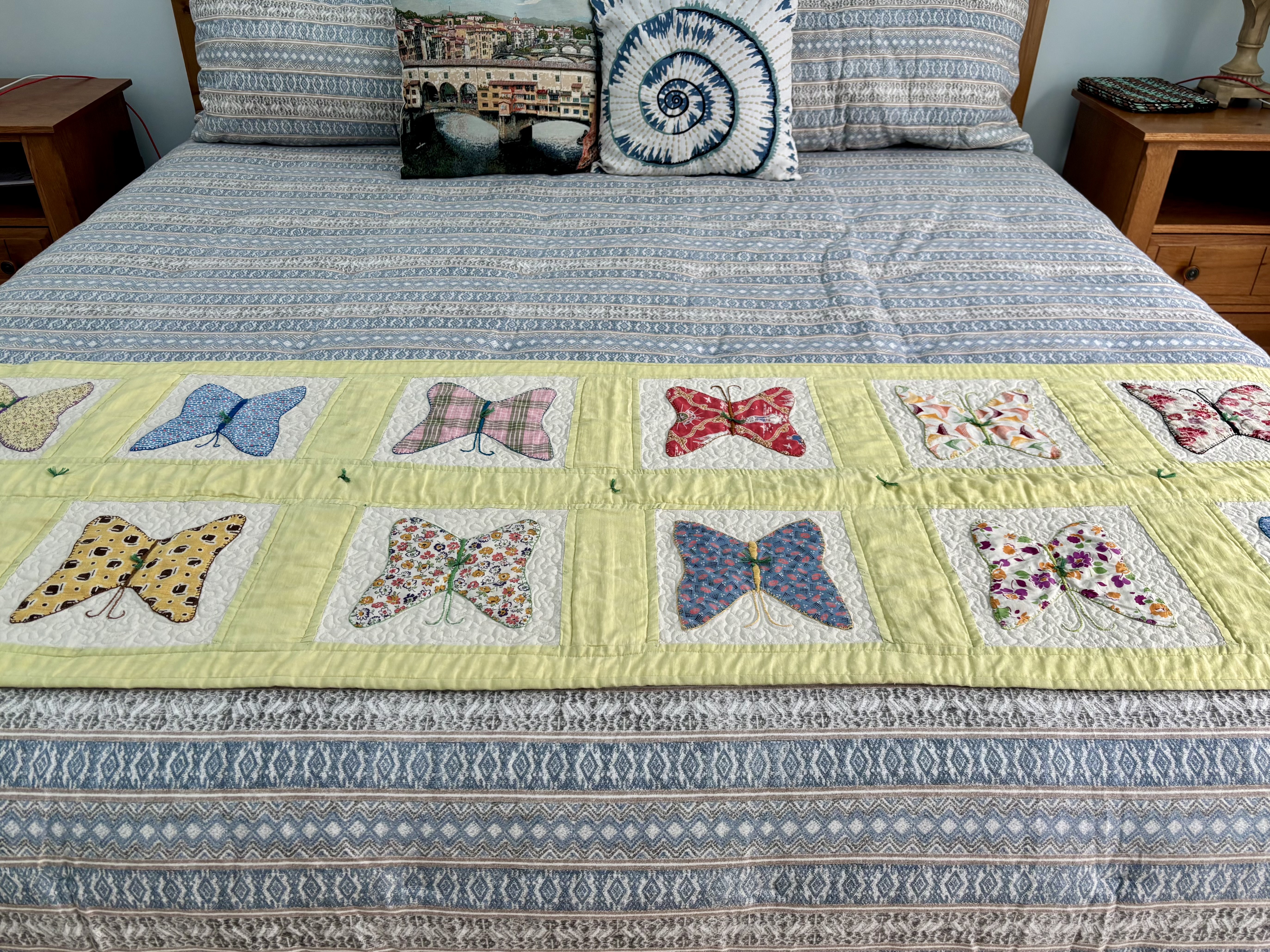
Eighty-five years after the Grecian sank to the bottom of the ocean, I was sorting through my mother’s and grandmother’s remaining belongings which were piled in my basement. I agonized over every item they had saved, from postcard albums to chamber pots, kerosene lanterns to crocheted doilies. Eventually the mountain dwindled to a small stack. I gave some items to my brother and sister, sold some at consignment shops, and donated other items to thrift stores. But I did not know what to do with two quilts, one a patchwork of butterflies, the other of girls in sunbonnets. Both quilts were fragile and worn, oddly discolored in some places. The butterflies and sunbonnet girls were appliqued to the backing, and the quilts were held together by hand-tied knots. They were not showpieces. Pinned to the butterfly quilt was a letter in my mother’s handwriting describing the origin of the quilts. The letter described the wreck of the Grecian and how the cloth was used. In part, my mom’s letter read:
“For many years afterwards, mothers and daughters wore dresses, aprons, and pajamas, and made curtains, sheets, and quilts from the same material. No one minded in school if you were wearing a blouse or dress exactly like the girl in the seat next to you.”
The letter explained how my grandmother, Marie, helped her 12-year old daughter, Georgette, make a quilt. She showed her how to tie the fabric to the batting with knots because it was easier than hand-quilting. A faded and saltwater-streaked green fabric became the border.
What a dilemma! I could not use the quilts as they were, but I couldn’t discard them. I’m not a quilter, and I actually shed tears, feeling unequal to the task. I didn’t want to keep my mother’s quilt hidden in a box, as it had been for so long. With the help of an expert quilter, I decided to have the butterfly quilt cut into three pieces, refilled, and re-tied, to be used as bed runners. I gave one each to my brother and sister, and kept one for myself. With the help of modern technology, I scanned my mother’s letter, and a photo of the original quilt onto fabric, which I attached to each runner.
Now, the butterflies grace the bed in my guest room, and I see them every day. I always think of that long-ago shipwreck, and my beloved grandmother and mother, working side by side sewing.