History on the Elbe
A Viking river cruise gave Lake Jeanette neighbors Margaret and Fritz Ritsch more than beautiful scenery—it offered unexpected lessons in resilience, remembrance, and the enduring value of freedom.
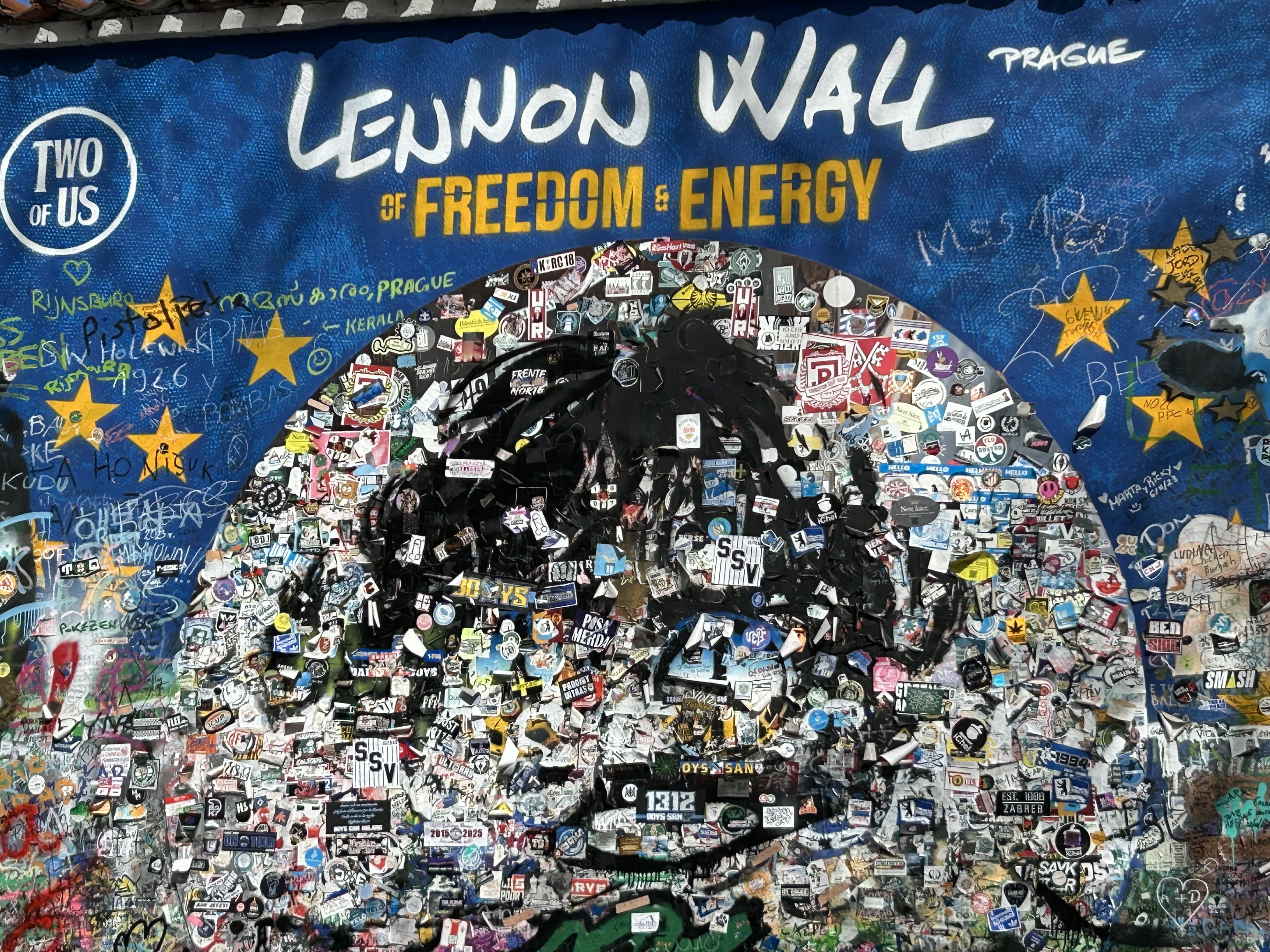
Peace Wall in Prague
Margaret and Fritz Ritsch expected stunning architecture, charming villages, and the relaxing pace of a Viking river cruise. What they didn't anticipate was how profoundly the journey would connect them with the people behind the history.
Traveling the Elbe River in April, the couple journeyed from Prague through Bad Schandau, Dresden, Meissen, Wittenberg, and Berlin. Between excursions, they watched the changing landscape drift past their cabin window, the water just feet below them.
"I found it soothing to be floating down the Elbe and watching the currents and changing landscape," Margaret says. "I slept so well, and overheard many others say the same. It must have been the gentle rocking of the boat."
One of the trip's most memorable moments came not in a grand cathedral or famous museum, but during a walk through the village of Torgau.
Their guide, Alan Custovic, shared the story of his grandfather losing the family farm during the Communist era. As he spoke, Margaret watched him struggle to hold back tears. He described how his mother and others of her generation still lower their voices in public places, shaped by decades when government informants were everywhere and speaking too freely could carry consequences.
"It wasn't the place that made the stop special," Margaret recalls. "It was hearing Alan's story."
Those conversations added a deeply personal dimension to the colorful murals of Prague, the remnants of the Berlin Wall transformed into public art, and the memorials honoring lives forever altered by war and division. History wasn't confined to textbooks or museums; it lived in the memories of people who had experienced it.
At the same time, the cruise itself delivered exactly what the Ritches had hoped for: relaxation without the stress of coordinating trains, hotels, and transportation between multiple destinations.
At the same time, the cruise itself delivered exactly what the Ritches had hoped for: a chance to slow down and absorb each destination rather than rush through it.
For Fritz, whose own memories include growing up during the Cold War, the experience carried an added layer of meaning.
"Having grown up during a time when the Iron Curtain divided Europe, it was especially moving to visit places that had once been behind it," Fritz says. "To stand there now, hear people's stories, and see how far they've come gave history a very human face."
The couple also appreciated the sense of community aboard the ship. Viking's dining rooms featured large shared tables, encouraging conversation among fellow travelers from across the United States and beyond.
"It's not possible to have a private dinner for two," Margaret says with a laugh. "I believe Viking river cruises encourage more socializing than ocean cruises."
When asked to summarize the experience, Margaret chose three words: stimulating, relaxing, and fun.