Into the Deep:
Exploring the Wonders of the Sea with Hilltop Residents Jaclyn Lim and James Tsui
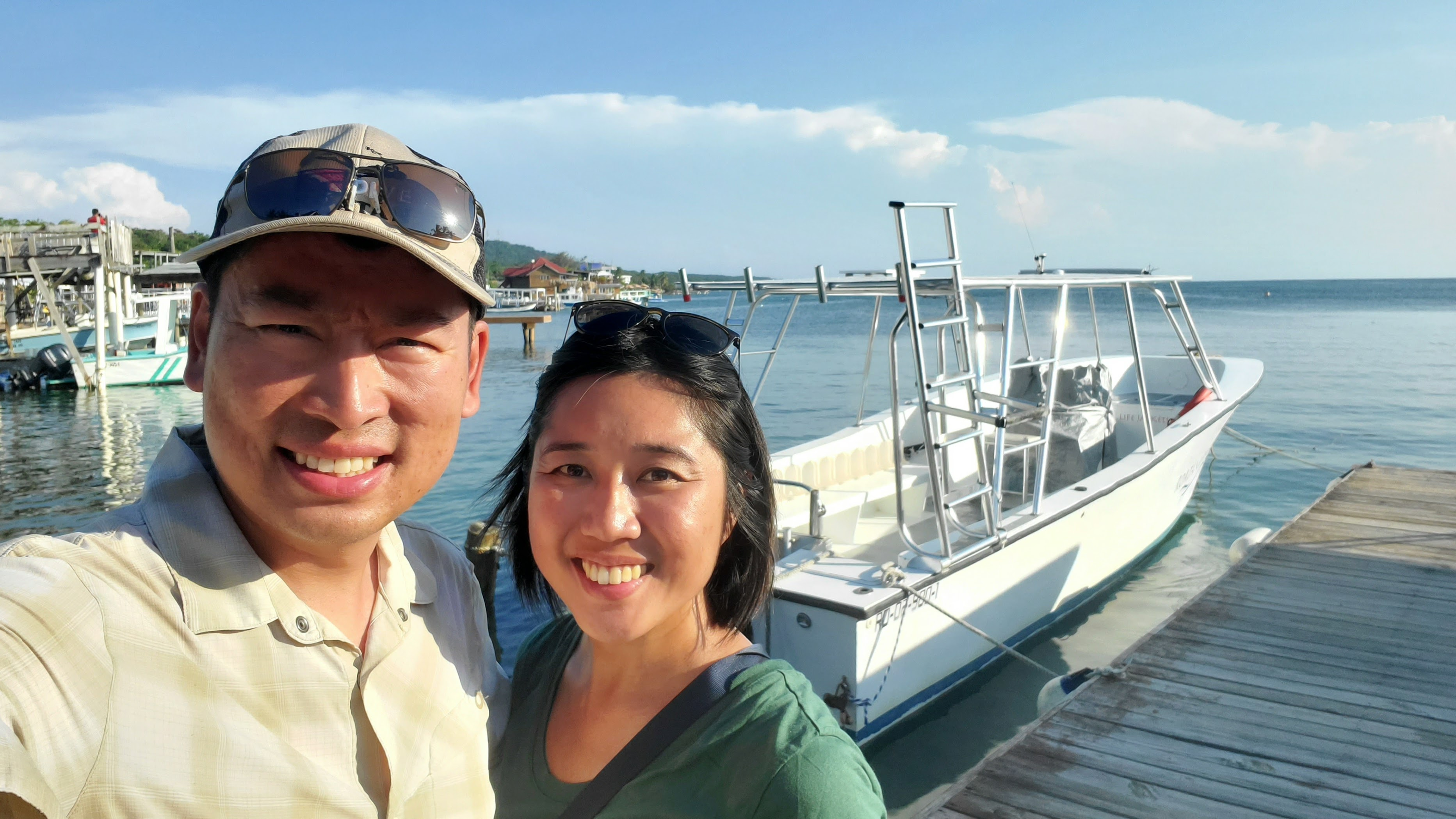
“Scuba diving has always been my thing,” says Jaclyn Lim. Seeing the wonders of the sea, including 16-foot manta rays just inches from you, is a once-in-a-lifetime moment.
From the moment she discovered the ocean’s depths, Jaclyn was hooked. In 2015, after spending two months in Australia and visiting Port Douglas, the gateway to the Great Barrier Reef, Jaclyn took her first discovery dive (where no certification is required) and fell in love. “There is always something about the ocean that has attracted me,” she says. That passion soon turned into a shared adventure with her husband, James Tsui, who was captivated by the sheer scale of marine life, from whale sharks to manta rays.
The couple earned their scuba certifications in Monterey Bay, California, that September and soon embarked around the world. By Thanksgiving, they were diving in Hawaii, exploring colorful reefs and seeing manta rays during a night dive near Kona, where the ocean transforms into a world of bioluminescence. “It’s just a different world down there,” Jaclyn reflects. “Everything slows down, and you get to be present with what you are seeing.” James adds, “It’s very peaceful. It’s like meditation. You have to control your breathing and move deliberately, which makes it therapeutic.”
Safety and respect for wildlife are essential. Sharks, turtles, and rays abound, but fear is never a factor. “You get very comfortable very quickly,” James explains. “As long as you don’t bother them, they leave you alone.” What about sharks? “They don’t see you as food,” points out Jaclyn, who jokes that perhaps she was a fish in a past life.
Their adventures have taken them to Belize, a haven for shark encounters, and even Roatan, Honduras, where the adventure seekers explored the Mesoamerican Barrier Reef, a protected ecosystem featuring over 280 maintained dive buoys. At Queen B dive site, 65 feet below the surface, they marveled at Southern Stingrays, Caribbean Spiny Lobsters, and Reef Lizardfish, all thriving amid coral nurseries.
Night dives offer an entirely different perspective, especially with nocturnal creatures. At Eel Garden, darkness brings predators out and a dazzling display of bioluminescence illuminates the water in tiny swirling galaxies. “It’s magical,” Jaclyn says. “It’s the closest you will ever come to being weightless and in outer space.”
For James, photography adds another layer of connection. Having owned a professional photography business, he appreciates the challenge of capturing marine life through a lens. The colors, angles, and light behave differently underwater, requiring both technical skill and patience. “It’s a whole new challenge,” he says. “You’re thinking about the dive and the photography at the same time.”
Their dives often include swim-throughs and wrecks. In Roatan, they explored El Aguila, a 230-foot ship intentionally sunk to create a dive site, now home to corals, reef fish, and schools of tarpon. Wreck dives are “disorienting,” according to Jaclyn, especially since it’s hard to tell which direction is up (except by seeing how your bubbles float). However, it’s also thrilling at the same time.
Despite the adventure, Jaclyn and James emphasize that diving is safe and accessible. Discovery dives around the world allow beginners to experience the thrill without certification, guided one-on-one by instructors who manage air supply and buoyancy. “All you have to do is breathe,” James says. Consider going to the Caribbean and Mexico, which are warmer and closer to Colorado.
What’s next for them? “The Galapagos Islands are on our bucket list,” says Jaclyn. “We also want to dive somewhere warm,” adds James. Raja Ampat is another location on their dive list.
We wish them safe dives wherever they decide to go next!
Bonus Travel Log from James Tsui:
Diving in Roatan, Honduras
As our plane descended into Juan Manuel Galvez airport, the anticipation for underwater adventures was just beginning. With over 280 maintained dive buoys and countless unmarked dive sites along the Mesoamerican Barrier Reef, Roatan in Honduras is an absolute diver’s paradise with marine protected areas supported by several conservation initiatives. With direct flights from Houston, Roatan is remarkably quick and easy to reach from Denver. Shortly after touch down, we made our way to our vacation rental in the West End, walking distance to all the dive shops and of course Half Moon Bay beach.
The first day, we hit the Queen B dive site – named after Brenda Balment who loved the coral nursery efforts of Roatan Marine Park so much that she donated to the cause and named a dive site after herself. Traversing Queen B at 65 feet below in 81 degree water, we were greeted with Southern Stingrays, Pederson Cleaner Shrimp, a Caribbean Spiny Lobster, and a Reef Lizardfish burrowed in the sandy bottom. Our dive guide deftly pointed out the hiding Spiny Lobster during the daytime dive, as they’re nocturnal and often tucked away under rocks during the day.
If you have the option, night dives are a must as wildlife during the night is generally completely different than during the day and with more predatory activity. So it was without question that later that evening we did a night dive at Eel Garden. Once we shut off our dive lights and allowed our eyes to acclimate to the dark, our underwater world transformed into a pitch darkness lit up by the sparkles of bioluminescence from dinoflagellates swirling all around us as we moved our hands through the water. It was as if tiny galaxies were forming and disappearing right in the palm of our hands. As we pressed further with our lights back on, sea urchins, lobsters, and crabs all came out to feast. Sea fans unfurled and expanded outward for filter feeding. The large Channel Clinging Crab is a sight to behold in person, as they can reach 12 inches from claw to claw making them an intimidating presence on the reef.
The next day, we headed to what turned out to be one of our favorite dive sites: Gibson Bight. While we couldn’t go to Mary’s Place due to strong currents, Gibson Bight had a few swim-throughs we were able to experience at about 60 feet deep. Swim-throughs are one of our favorite parts of diving as they add uniqueness to a dive site while often providing closer encounters to wildlife in their habitat. Gibson Bight turned out to be a marine delight with numerous nudibranchs, a Spotted Drumfish, massive Atlantic Tarpons, and even some Moon Jellyfish.
Of course, no diving trip would be complete without a wreck dive if one is available, and for us that was El Aguila. El Aguila, Spanish for “The Eagle,” is one of the Caribbean’s most popular wreck dives and measures 230 feet from bow to stern. For several years, Anthony’s Key Resort had been looking for a ship to convert to a wreck dive, and purchased it and sank it in 1997. One year later, Hurricane Mitch came in October 1998 and split the ship into three pieces providing several areas for both divers and wildlife to explore.
Finally, the local hospitality is not to be overlooked. Ten dives in five days will drive an appetite; seek the warmth and creativity of local establishments like Loretta’s Island Cooking, Anthony’s Chicken, Stowaway Gastrobar, and Junior’s Patio.
The culmination of our Roatan adventure was not just in the extraordinary dives at sites like El Aguila Wreck and Black Rock, or the magical night dive where bioluminescence turned the sea into a starry night. It was in the blend of experiences – the thrill of adventure, the beauty of nature, the warmth of culture, and the moments of tranquility – that Roatan offered. The island was more than a destination; it was a journey that touched every sense and emotion.