Fighting with Family and Friends - Mixed Martial Arts with Mark Levine
Inspired by his love of strategy and play, Mark has spent the last twenty years perfecting his skills of practicing and teaching mixed martial arts.
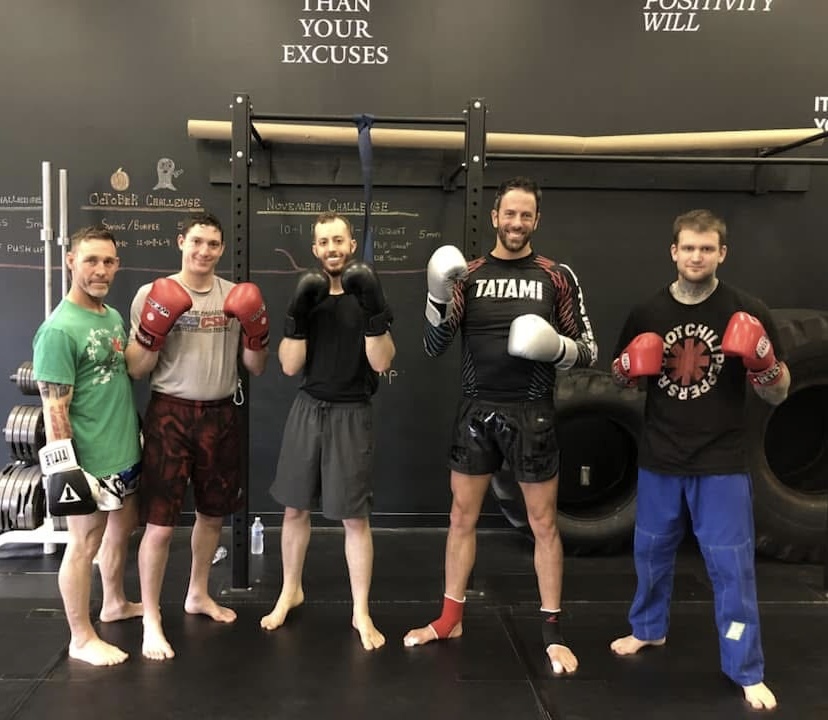
I had the pleasure of sitting down with neighbor Mark Levine. This upcoming fall will mark nine years of living in Hidden Lake. When asked about the neighborhood, he shared his love of the communal aspect of Hidden Lake. “Hidden Lake is filled with people that are comfortable enough to boat together, surf together, socialize together, and raise their children together.” Mark shared, “I love our community.”
Community is the same thread that connects him to his passion, mixed martial arts.
Mark’s journey through martial arts has spanned over the past twenty years. What started as a pivot from traditional sports and exercise has developed into a deep dedication to the sport.
Mark’s twin brother, Daniel, has been participating in martial arts for most of his life. While his brother’s path was martial arts, Mark chose powerlifting and other sports, like basketball, volleyball, tennis and golf. After navigating multiple injuries from powerlifting, Mark saw an opportunity to pivot and started combat martial arts.
He started training Muay Thai, Dutch-style kickboxing, and Western boxing at a mixed martial arts (MMA) gym while living in Chicago.
Martial arts include a multitude of combat styles, including striking arts such as Karate, Taekwondo, and Muay Thai, and grappling arts, such as Brazilian Jiu-Jitsu, Sambo and Judo. “Muay Thai is a Thai form of striking with roots that trace back 1,500 to 2,000 years .”
MMA is a mixture of both striking and grappling, creating its own techniques that bridge both styles. Muay Thai, for example, is built on striking while standing, emphasizing kicks and punches using knees and elbows. In comparison, Brazilian Jiu-Jitsu (BJJ) is a grappling martial art that focuses on bringing the fight to the ground using techniques such as throws, joint locks, and chokes.
After years of training then teaching Muay Thai, Mark gained a curiosity for Brazilian Jiu-Jitsu after watching others at his gym grapple and seeing larger and stronger fighters get dominated by their smaller opponents. “You go to your Muay Thai class, but you see everyone else grappling,” he stated. “I decided to take one class, and I was hooked.”
Since his initial interest, Mark has been training in Muay Thai for fourteen years and Brazilian Jiu-Jitsu for eleven years. “Contrary to common misconception, it’s a very familial atmosphere. You end up making a lot of life-long friends …while trying to choke and punch each other.” He laughs. “Many of my closest friends over the last 15-20 years are rooted in the gym.”
His love of the sport grew so much he dived into teaching, something he has done for the last six years. He currently teaches at the Freedom Martial Arts Academy in Brighton.
Grappling is a complement to his career as a patent attorney. “Grappling requires dedication, focus, strategy, and controlled execution,” he shared.
This past January, Mark achieved an incredible accomplishment by earning his brown belt. Only 3-5% of individuals who start Brazilian Jiu-Jitsu receive a brown belt, putting Mark in an elite group in his sport. Because Brazilian Jiu-Jitsu values continual training with time spent on the mat and sparring over merely memorizing movements, the evolution is much slower and more stringent compared to other martial arts like Karate and Taekwondo. Even more stringent, Muay Thai does not award belts or ranks; you train and you fight. “It’s a sport where you have to prove your worth. It’s about commitment, time on the mat, and tangible progress.” Mark said.
Over the years, there’s one story that stands above the rest. After years of powerlifting and fighting Muay Thai, Mark took a beginner Brazilian Jiu-Jitsu class while he was living in Chicago. The instructor, a Serbian black belt and lifelong practitioner of BJJ, was rolling with other students, a Jiu-Jitsu term that is similar to sparring or fighting, where a person will face their opponent to test their current skill level. From appearance alone, Mark had the advantage: he was significantly taller and at least 60-65 lbs heavier than his instructor. When it was Mark’s turn to roll, his instructor closed his eyes and defeated Mark in 25 seconds! He did it again with his eyes closed in 20 seconds. As a final show of skill, his instructor pulled his hand behind his back, kept his eyes closed, and still defeated Mark. What Mark had in stature, his teacher made up for with his experience and skill . “The best grapplers are the smartest grapplers.” Mark said. Years later, that experience has left an imprint on Mark’s mind. It demonstrated the combination of inner play, physicality, nuance, and strategy someone grows into as a result of practicing martial arts.
Mark encourages everyone to try martial arts. It draws in people from all backgrounds. Mark encourages, “There are a number of people that show up with no self-defense or martial arts background. I train everyone from vets and police officers to teachers and professors.” For those who have never participated in martial arts before, there are two main changes Mark notices, “The biggest draws are confidence and self-awareness. You often get someone with no background or experience in fighting, and within a year you can see a noticeable change in their demeanor, the way they carry themselves, and their confidence when they are put in a high-stress scenario.”
From Hidden Lake to Freedom Martial Arts Academy, Mark is building family and strengthening his community, one person at a time.