DALE NEAL - New Release FLOODMARKS
The Heart of the Storyteller
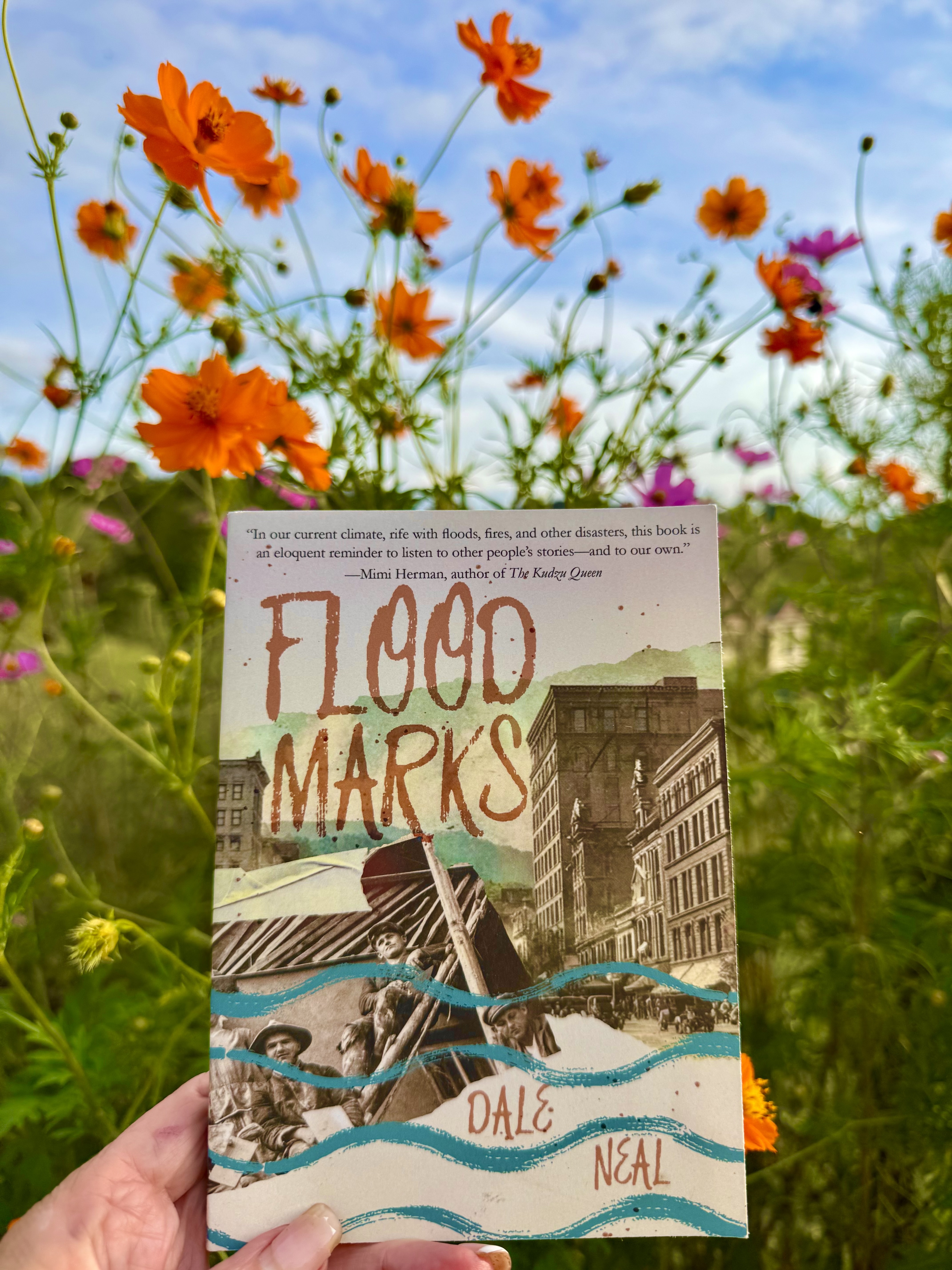
They say history doesn’t repeat itself, but it certainly rhymes, and fiction can’t help but follow in its wake.
My upcoming novel, "Floodmarks" is winning advance praise from Foreword Reviews as thoughtful and powerful, evoking how our past haunts our present, with “ruminations on the impermanence of memory, the power of redemption, and the truth buried in both.”
In 1986, my last year at the Asheville Citizen-Times, I researched, reported and wrote a long feature story on the devastating Flood of 1916 that marooned the mountain town for months. My friend and fellow writer Mc McIlvoy admired my journalism, and told me, “You know this is a novella.”
I did not know that. I’d never written one before.
After I was laid off from the newspaper, the fate of far too many American journalists, I mulled that idea over in the back of my mind. In 2024, I sat down and wrote the story of hapless George Flack, the cub reporter trying to get at the life story of Miss Nellie Lusk, the last living survivor of the Flood. Miss Lusk is still angry that his newspaper had never offered a formal correction and apology for mistakenly listing her among the dead 70 years before.
Regal House was interested in my tale, and I signed a contract that summer for “Floodmarks.” Two months later, what happens but Hurricane Helene, following the same patterns as the 1916 tropical storms that had brought devastation up and down the French Broad River and across the western half of North Carolina.
But Helene was even more hellacious, breaking all of 1916’s records for flood stage, leaving 100 people dead across the Tar Heel mountains and billions of dollars in damage.
Two years later, Asheville and the surrounding area are still recovering. Some places, along the river seem like nothing has happened, the placid currents flowing along restored walking paths and bike lanes. But go down river, you’ll pass still abandoned buildings with graffitied walls. And some areas of hard-hit Swannanoa remain horribly scarred and almost untouched since the waters receded. Federal money promised by our politicians has been woefully slow.
Too many locals feel a strange pit in their stomachs whenever the wind picks up and a storm blows overhead. You don’t ever forget the force of a wall of muddy water more than three stories higher than a person roaring down a riverbed or howling winds ripping and uprooting giant trees and forests on high ridges.
Writing "Floodmarks", I wanted to explore how people deal with devastation and loss of their everyday lives, how they have to find the wherewithal, the courage to rebuild their lives, to live on. I took for my epigraph from a letter that my literary idol Thomas Wolfe had written to his own sister in 1929. “I have a thing to tell you now: that is, you can’t go home again, but there are other places you can go. So why not try to find them?”
I also wanted to pay tribute to my old newspaper, the Asheville Citizen-Times, where I worked and wrote for 34 years. American newspapers have largely dwindled away in the past decade, due to the Internet and the greed of private equity owners looking only for profit at the expense of informing our citizenry.
George recounts his nights working with seasoned and jaded journalists at the Citizen-Times at its old headquarters on O. Henry Avenue across from the storied Grove Arcade. My novella resurrects names and faces familiar to long-time subscribers of the newspaper in its heyday. Tony Kiss, John Parris, Jay Hensley, Lewis Green, Steve Dixon, Phil Luther, Lucille Hearn, among others.
"Floodmarks" is my elegy for the Asheville I found when I first moved here in 1983. What I’ve discovered is that our town has always been changing decade after decade almost from its start. As Wolfe said, we keep making and remaking ourselves at home in these ancient hills.