Community Takes Stage
The Dorset Playhouse’s 21st Annual One-Act Festival explored the many meanings of community through performances of six short plays. The director of The Lottery, Kevin O’Toole, and the director of The Laundromat, Cheryl Gushee, reflected on community in their respective plays.
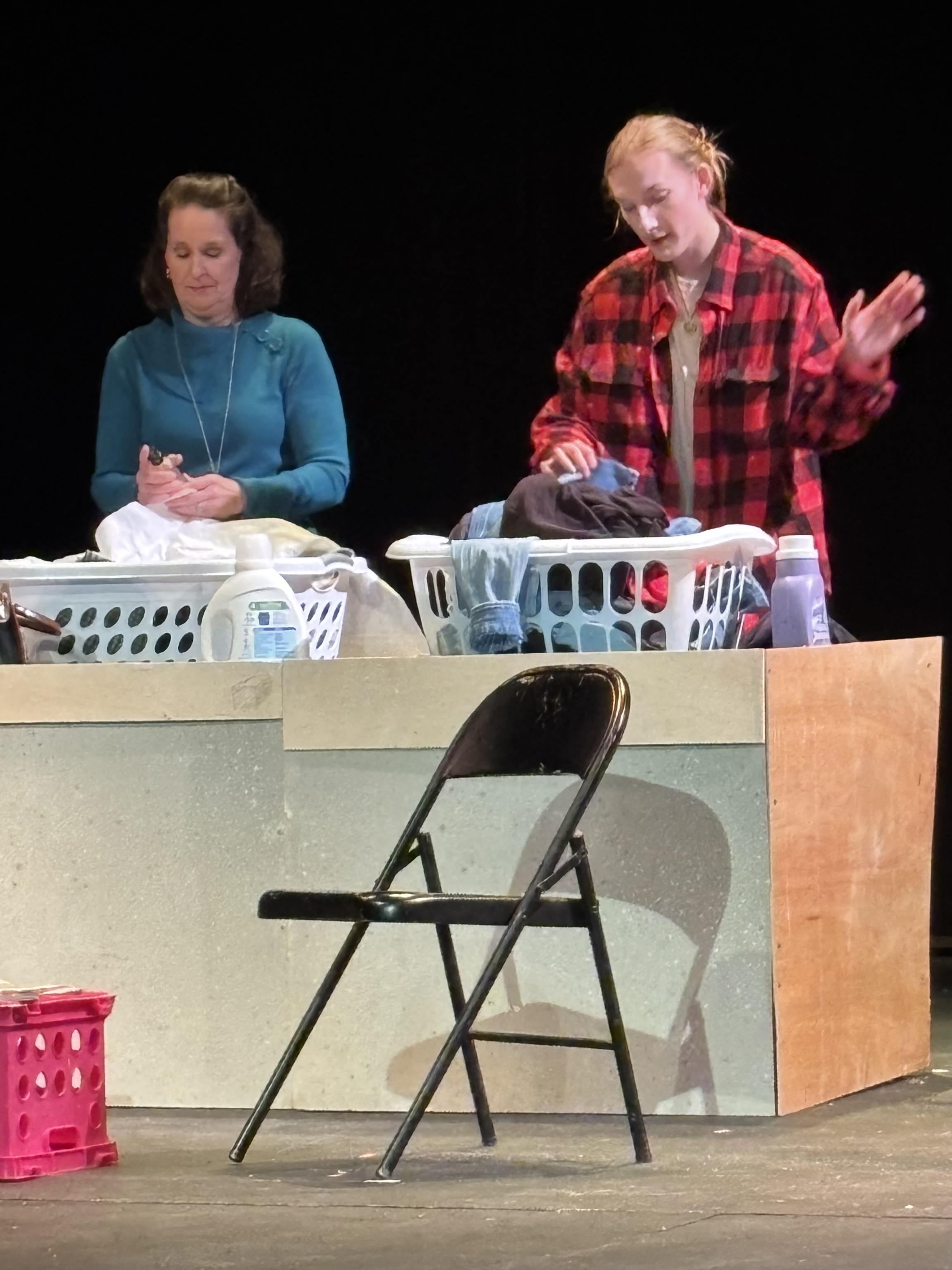
The Laundromat
Kevin O’Toole, a longtime fixture of the Dorset Players, has participated in the Oct-Act Festival since its inception in 1987. O’Toole has served in nearly every imaginable role over the decades from actor, director, producer, sound and lights, board president, stage manager, and even bottle washer, he jokes.
He proposed Shirley Jackson’s The Lottery multiple times before it was finally accepted this year and was even told once, “I can’t imagine why anyone would want to do that play. You must be sick!” Originally published in The New Yorker in 1948, the short story famously generated widespread reader responses, and its shocking conclusion continues to unsettle readers.
Set in an agrarian village where families gather every June 27th for an annual lottery, the story unfolds with quiet normalcy. Gradually, the audience grasps the ritual’s true purpose.
“The horror of the story is in its mundaneness,” O’Toole explained. “It’s just like any other day, except it’s not. And everyone accepts it. Everyone accepts it until it’s you.”
For O’Toole, the play’s power lies in its examination of unexamined tradition. “My mother used to say, ‘If everyone jumped off a cliff, would you do it too?’ Sadly, most would… just to go along.”
O’Toole acknowledged that audiences may see their own reflections in the story’s portrait of conformity and communal pressure. The play closes the festival’s first act, a placement he believes allows its weight to linger.
“I wouldn’t want it followed immediately by a comedy,” he said. “Hopefully, it gives people something to talk about at intermission.”
While The Lottery examines community at its most collective, The Laundromat, directed by Cheryl Gushee, focuses on a single late-night encounter between two women over a wash and spin cycle.
Gushee, now in her tenth year with the Dorset Playhouse, studied acting in New York before returning to theater after retirement. She has previously directed Sure Thing, Sylvia, and A Christmas Carol for the company.
Drawn to the work of women playwrights, Gushee chose Marsha Norman’s The Laundromat for this year’s festival.
The 30-minute play unfolds at 3 a.m. in a small-town laundromat. Alberta, a recently widowed middle-class woman, arrives hoping for privacy and solitude to wash the clothes her husband was wearing when he died ten months earlier.
Instead, she encounters Deedee, a young, recently divorced Appalachian woman. Deedee, too, is searching for refuge.
“They’re completely opposite in background and personality,” Gushee said. “There’s a strong issue of class in the play. At times, Alberta is charmed by DeeDee; at others, she is offended by her bluntness. Beneath their differences lies shared loneliness, disappointment, and grief. Each is facing a turning point in her life. And although age and class separate them, they find support in their short time together.”
“It doesn’t really matter what class you come from,” Gushee reflected. “Core emotions are the same.”
Though the two women will likely never see each other again after that night, the laundromat becomes a temporary sanctuary, a safe place where they can speak honestly and be heard. The play is also about reinvention, “a skill often required of women,” Gushee reflected.
“Community is a place where you feel safe,” Gushee said. “It’s a place of trust. Both of these women find a temporary safe place. Unexpectedly, they also find each other.”
One of the enduring pleasures of the One-Act Festival, for O’Toole, is watching a company find each other and form around each production.
“You start with a group of individuals,” he said. “If you’re lucky, somewhere along the way they become a company. All for one and one for all. Then after the final performance, poof. It’s gone.”
That fleeting quality, the sense that something powerful happens and then disappears, is a singular quality of act-one plays. O’Toole describes the form as: “a clever idea that runs out of gas quickly or a complete story that simply doesn’t take long to tell.” Those who attended this year’s festival were lucky enough to witness these fleeting moments on the playhouse stage.