MASTERING THE ART OF COMPOSING
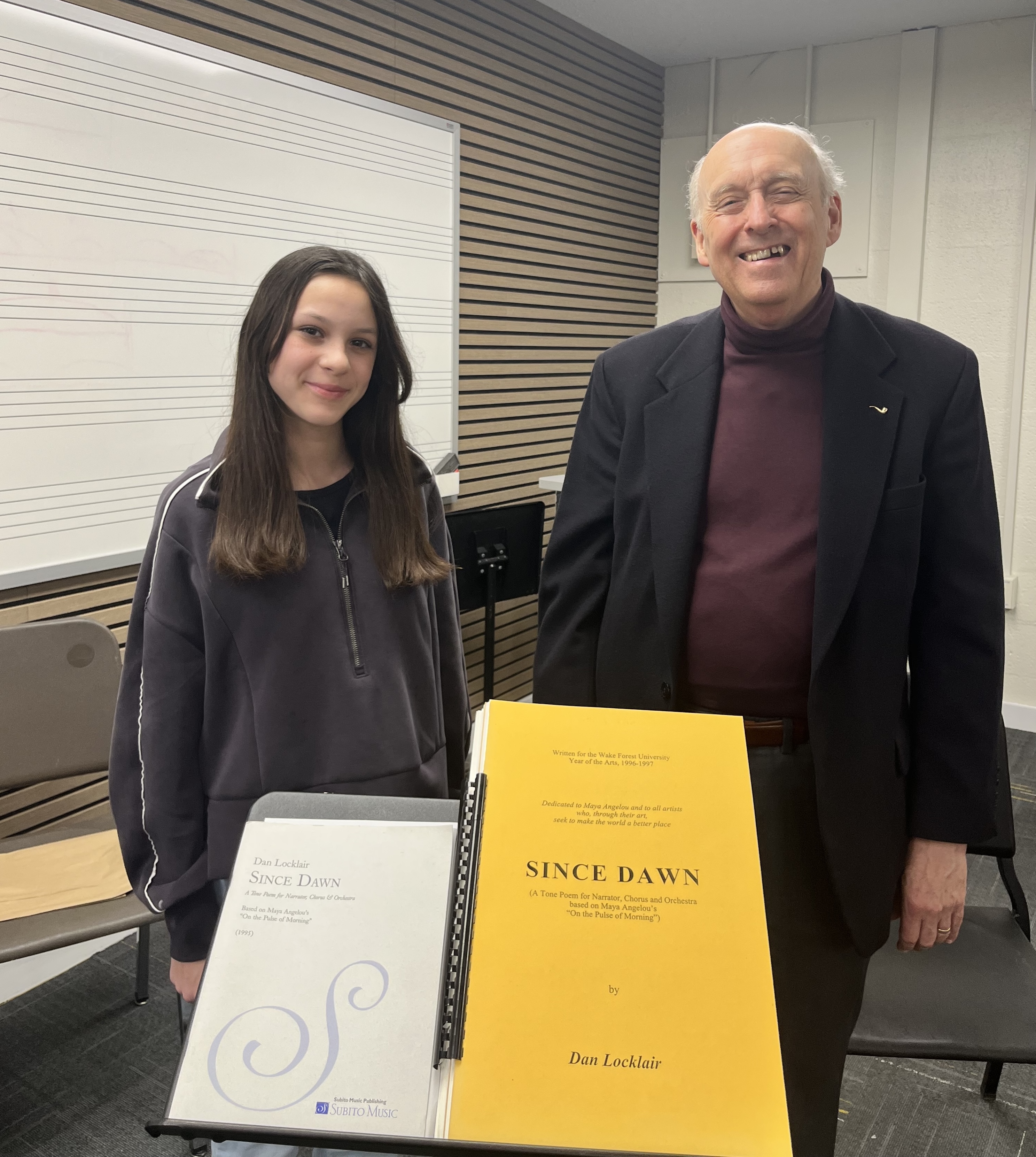
Who do you think of when you hear the words “classical composer?” Do you think of someone like Bach, Beethoven, Mozart, Vivaldi, or Handel? What if I told you that people still compose classical music to this day? I had a great opportunity to interview the classical composer, Dr. Dan Locklair, who composes classical music today.
Dr. Locklair grew up in the Charlotte area. Neither of his parents were musical, but they encouraged and supported his musical pursuits. He started playing the piano at the age of six and began playing the trombone in fourth grade as part of his public school’s music program. He was also exposed to the pipe organ and choir music at the church he attended as a young man. Dr. Locklair believes knowing an instrument is an essential skill for any composer. Almost every music composer was an accomplished instrumentalist. Bach played the harpsichord and the organ; Beethoven and Mozart played the piano.
His aunt remembers Dr. Locklair writing simple melodies at the piano around the age of 7 or 8. His first recollection of composing was at age 14, when he wrote music for his school choir and orchestra. At this point in his life, he couldn’t imagine a life without music. Therefore, he pursued composing as his career. He recently retired from a full-time position at Wake Forest University after 43 years. He still teaches as an adjunct professor at Wake Forest but spends most of his time composing music.
The performance of Dr. Locklair’s music has given him unique opportunities to travel around the United States and the world. His music has been performed in our country at places like Carnegie Hall, the Kennedy Center, and Harvard University. Worldwide, musical groups in London, Japan, Finland, and beyond have performed his songs. One of his most memorable performances was in the Czech Republic at the Czech Festival of Choral Arts. He was the first American composer to be invited to this festival, and he went only two years after the Velvet Revolution. This revolution removed communism from Czechoslovakia.
Some of the wisdom he shared speaks not only to musicians, but anyone who pursues an art form - such as poetry, story writing, and visual art. You have to have training in the art you want to pursue. Great artists have wonderful ideas, but they also have the skill to make those ideas come to life. Dr. Locklair wisely states that "inspiration is a seed that gets something going. But if you don’t have craft, you can have all the inspiration in the world and you’ll never create anything of quality.”
Sometimes artists get stuck, lack motivation, or don’t have any ideas. A simple way to get your mind off of it is to do something else. It doesn’t even have to be related to what you're working on. Go take a walk, wash dishes, or do lawn work. He said some of his best ideas came to him even when he wasn’t working on his piece. He does say do not procrastinate. Sometimes you just have to sit down and get your work done.
A lot of music today is written on computers. You could even tell AI to create something for you. But Dr. Locklair writes all his music with a pencil. He views his pencil, which he can hold in his hand, as an extension of what he hears inside of him. Dr. Locklair told me that he believes “the pencil is the closest to the human heart.”
If you are interested in hearing one of his pieces live, the Winston-Salem Symphony and Chorus will perform his piece SINCE DAWN on Saturday and Sunday, May 30 and 31. This piece of music is based on a poem by Maya Angelou. Her poem uses three key words: a rock, a river, and a tree. Dr. Locklair composed three musical pictures to go with the three key words. It is rare to hear a piece by a living composer. You can buy tickets and learn more about the Winston-Salem Symphony at https://www.wssymphony.org. To learn more about Dr. Dan Locklair and his music visit: https://locklair.com