The Sphinxes of Forsyth Park
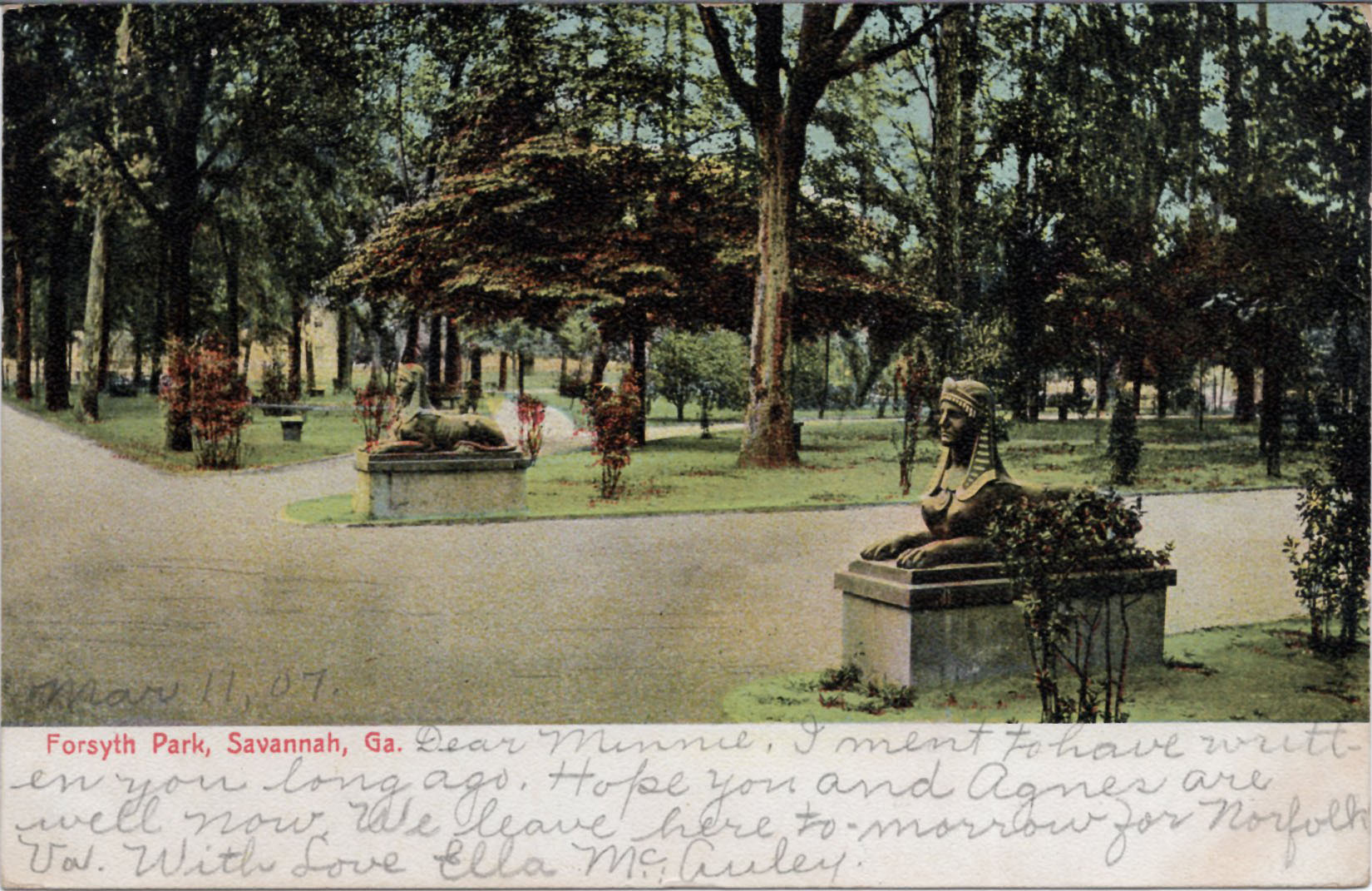
The northern entrance to Forsyth Park, at Bull and Gaston, was once guarded by a pair of sphinxes, shown here, which have since vanished. They were installed in January 1872 by Alderman John Ferrill, chairman of the Committee on Parks. Cast of zinc alloy by the Fiske Foundry of New York, the sphinxes were a tad more than five feet long by three feet high. They were painted a dark green, probably imitating patinated bronze, with details of headdress and necklace picked out in gold paint. Originally, when the park was enclosed by a Wickersham iron fence, they crouched behind the principal gateway. The fence was removed in 1896.
Sphinx lore was all the rage during the Victorian era, fueled by a fascination with ancient Greece and Egypt, both cultures employing sculptured sphinxes as guardians. The Forsyth sphinxes were a hybrid of these traditions: a bare-breasted female from the Greek type, but wingless, like the Egyptian, and wearing an Egyptian nemes headdress. They were repainted green and gold in 1891 and then painted white in 1897. Nothing more about them appears in newspapers until 1900, when the sphinxes were addressed some twenty-five times between March and June. In summary: The sphinxes were removed on March 19th due to their dilapidated condition, by order of Philip Daffin (namesake of Daffin Park), chairman of the Park and Tree Commission, who expressed distaste for the sculptures. Their removal sparked public outcry and opposition from Mayor Herman Myers, who noted that their removal was not approved by City Council. A protracted dispute followed over legal protocol and whether the sculptures could be restored. In the end, they were restored and returned to the park in early June but in a new location, about ten feet back (south) from the original site.
The Savannah Morning News, a principal source, is not digitized beyond 1904, but the 1905 annual mayor's report states that the sphinxes were repainted that year. They are next noted in the 1915 mayor's report which states that the "remaining" sphinx was crushed by a fallen tree and removed. This was the sphinx on the west side, verified through postcard images and a photograph. Further evidence from postcard copyright dates and postmarks suggest that both had survived until at least 1907. For now, further details of their fate shall remain enigmatic, like the riddle of the sphinx. The postcard depicted here is postmarked March 1907 but derived from a photograph made no later than 1897, showing them in their original location with the original color scheme.